




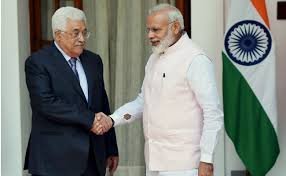
 Palestinian President Mahmoud Abbas’s four-day state visit took place at a time when the government of Prime Minister Narendra Modi is breaking new grounds in the realm of country’s foreign policy. Modi reconfirmed to Abbas after talks India’s unwavering support to the Palestinian cause. India hopes “to see the realization of a sovereign, independent, united and viable Palestine, co-existing peacefully with Israel”, the prime minister said in his statement. The two leaders agreed that India and Palestine, through practical cooperation, will work together to build Palestine’s economy and contribute to improving the lives of its people. “We will continue to support the skill development and capacity-building efforts of Palestine”, Modi said. Five agreements, including in the area of information technology, electronics, agriculture, health,youth affairs and sports, including Yoga,were signed between two sides in the presence of two leaders. Mr Modi also referred to a flagship Techno-park project India was undertaking in Ramallah. Once completed, it will serve as an IT hub in Palestine offering a one-stop solution for all IT related training and services. Mr Abbas, while expressing his appreciation for India’s continued support and solidarity for the Palestinian cause on international fora, updated Mr.Modi on his meeting with US President Donald Trump regarding the Middle East peace process as well as his talks with German President Frank-Walter Steinmeier and Russian President Vladimir Putin on the issue. Stepping a little away from the traditional road to Palestine-Israel issue, Mr.Abbas’s fifth visit to India had come before MrModi’s stand-alone visit to Israel in July, ending the earlier practice of including the two countries in official visits by leaders. India’s relations have been exponentially growing with Israel, with Tel Aviv becoming a strategic partner in supply of weapons and internal security systems along with deepening cooperation in the field of agriculture and water technologies. In a balancing act, New Delhi had invited the Palestinian President to reaffirm country’s support to the Palestinian cause and to clear misapprehension that may arise through Mr.Modi’s Tel Aviv journey. There was a strong possibility that the prime minister’s decision of not paying even a symbolic visit to the Palestinian territory may not be taken in a positive light by the Palestinian leadership as both the BJP’s and Modi’s love for Israel is well known. Mr.Abbas’s India journey is taking place at a crucial juncture when Mr Trump is set to visit later this month to the Middle East to explore a permanent solution to the Israel-Palestine dispute. Over a dozen heads of state from Arab and Islamic nations have been invited to a conference in Saudi Arabia next Sunday. The US President will also expected to attend it. Immediately after the conference, Trump will fly to Jerusalem where he will meet Prime Minister Benjamin Netanyahu and other Israeli leaders. Both Abbas and Netanyahu have been to Washington and have held talks with the US President. Mr.Trump is said to be very keen to push for peace talks between Israel and Palestine that can pave the way for a permanent solution to a long standing problem.Already, MrTrump’s son-in-law and senior advisor Jared Kushner is involved in the process meeting Israeli and Arab leaders in recent months to understand the climate of understanding in the region. Palestine has always been very keen that India plays a bigger role in the Middle East peace process. The Modi regime may like to take a lead in this direction and in this background,Mr.Abbas’s visit may prove to a balancing act in the country’s diplomatic efforts to have confidence of the conflicting sides.