





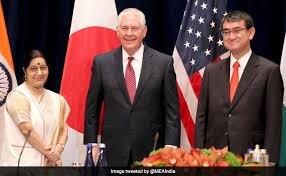
India’s External Affairs Minister Sushma Swaraj met US Secretary of State Rex Tillerson and Japanese Foreign Minister Taro Kano on the sidelines of the UN General Assembly meeting in New York City taking up issues of connectivity, security and respect for international norms. The joint statement of the ministerial meeting highlighted three key areas – maritime security, connectivity and proliferation. On South China Sea and OBOR In an oblique reference to China, the statement stressed the need for “freedom of navigation, respect for international law and peaceful resolution of disputes”. China’s aggressive posturing on South China Sea where it is ramping up its military presence and accelerating construction of artificial islands has caused considerable distress to the international community since the annual global trade flow through these waters amounts to many trillions of dollars. China’s One Belt One Road Initiate also figured in discussions. It has been opposed to it from the very beginning since a major part of it passes through Pakistan occupied Kashmir. The joint statement called for the need to base such initiatives on “universally recognized international norms, prudent financing and respect for sovereignty and territorial integrity”. It may be noted that US had urged a return to status-quo during the Doklam crisis while Japan had actively supported India’s position. On Pakistan – North Korea nuclear nexus The joint statement explicitly referred to DPRK’s (Democratic People’s Republic of Korea) deplorable activities. The “proliferation linkages” is a clear indication to Pakistan’s hand in North Korea’s nuclear weapons programme which goes back to the 1970s when Islamabad-Pyongyang security partnership was forged between the two countries. In 2004, Pakistani nuclear scientist A.Q. Khan had admitted to have transferred nuclear technology to the rogue regime. The recent missile launch over Japan has proved that UN sanctions have hardly been a dampener for Kim Jong-un’s leadership. The US administration has made it clear that it is not ruling out a military solution though it remains a precarious assertion.