



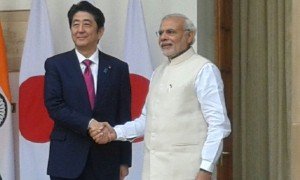
When Shinzo Abe secured a landslide victory in the national election on October 22, making him one of the longest-serving leaders of post-war Japan, one of the first congratulatory messages to reach him was that of his Indian friend, Prime Minister Narendra Modi. “Heartiest greetings to my dear friend @AbeShinzo on his big election win,” tweeted an elated Mr. Modi. “Look forward to further strengthen India—Japan relations with him.” Mr. Abe is one of the few world leaders with whom Mr. Modi shares a great personal chemistry and is also engaged in various joint initiatives both domestically as well as internationally such as the Asia-Africa Growth Corridor which is widely seen as a counter to China’s Belt and Road Initiative. Mr Modi literally rolled out the red carpet for Mr Abe during his visit to India in September, which saw the formal stone-laying ceremony of India’s first bullet train that will link India’s commercial capital Mumbai to Ahmedabad. Mr Abe’s re-election means the upswing in India-Japan relations will continue with greater pace and vigour under his dispensation for the next few years. Japan has emerged as India’s key partner in India’s ongoing project of national rejuvenation, with Tokyo pledging funds and expertise for a host of transformative infrastructure projects in the country. Tackling North Korea One of the other important calls to Mr. Abe was from US President Donald Trump with whom he has been working closely to ramp up pressure on North Korea’s Kim Jong-un’s rogue regime to give up its nuclear pursuit. Besides calling up and congratulating him on his resounding win, Mr. Trump also set up a golf date with Japanese champion Hideki Matsuyama during his upcoming visit to the Asian country early next month. Wracked by a series of corruption scandals earlier this year, Mr. Abe’s approval ratings nosedived to 26 per cent and with mounting opposition, his position looked bleak for a while. But his aggressive stance and deft diplomacy in the face of the rising North Korean missile threat appears to have swayed public opinion more favourably towards Mr. Abe’s party coalition. “My immediate task is to deal with North Korea,” said Mr. Abe after marking his decisive electoral win. “It will take tough diplomacy. With the mandate given by the people, I would like to exercise my command in diplomacy.” With opposition parties in a disarray and no strong leader to challenge him except his former defence minister Yuriko Koike, who had launched a new party but decided against standing for election, Mr. Abe’s win was a foregone conclusion. With a whopping 312 seats in the 465-member Lower House, his conservative Liberal Democratic Party coalition has got back a comfortable two-thirds majority. The “supermajority” has sparked speculation on Mr. Abe’s longstanding goal of amending the post-World War II US-sanctioned no-war charter. Speaking to reporters on the amendment of the constitution, Mr. Abe said: “We won a two-thirds majority as the ruling bloc, but it is necessary to strive to form a wide-ranging agreement among the ruling bloc and opposition to revise the constitution. Also, we aim to win the understanding of the people, so that we can gain a majority in a referendum.” Meanwhile, when asked about Mr. Abe’s stunning comeback and a possible amendment of the country’s pacifist constitution, Chinese Foreign Ministry spokesman Geng Shuang had a guarded response. He said that he hoped Japan “continues to follow the path of peaceful development and play a constructive role in promoting peace and stability in the region.”