







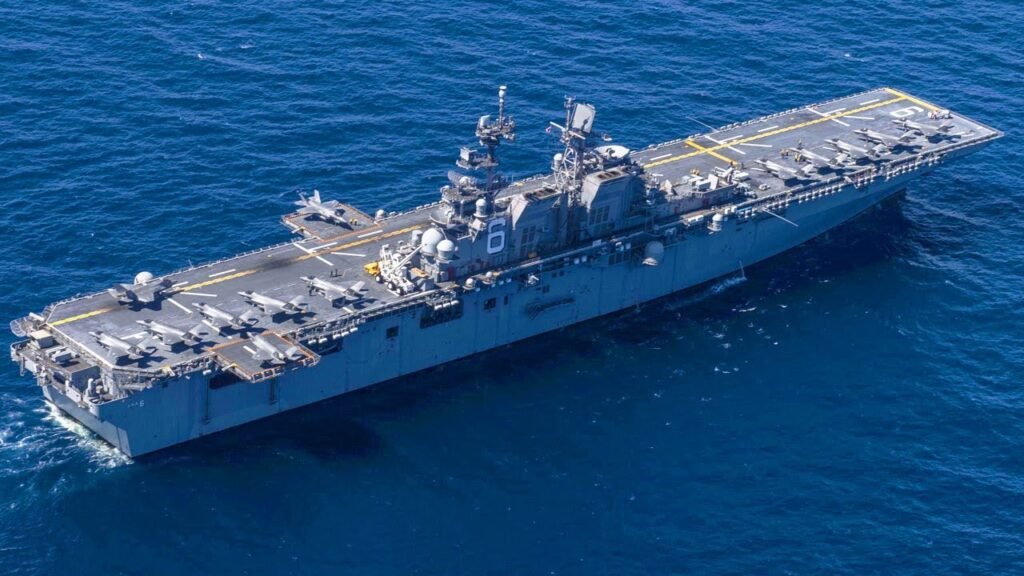
Tensions over territorial rights flared up again between the US and China in South China Sea after two American battleships sailed past the waters this week, The New York Times reported citing observers. The latest excursions of an amphibious assault ship, The USS America, and a guided missile destroyer, the USS Bunker Hill, come amid an ongoing spat between the two countries over the COVID-19 pandemic. President Donald Trump has blamed China’s dubious crisis management that led to the unrestrained spread of the virus outside its borders. According to the Times report, tensions have been simmering in the region for several days now after the US naval ships entered the contested waters off Malaysia. It comes amid reports of a Chinese ship tailing “for days” a Malaysian vessel carrying out oil exploration drills in the sea.“It’s a quite deliberate Chinese strategy to try to maximize what they perceive as being a moment of distraction and the reduced capability of the United States to pressure neighbours,” the newspaper quoted Peter Jennings, a former Australian defence official, as saying. Since January, the Chinese coastguard ships, along with maritime militias, have been harassing the maritime agencies and the fishermen of the neighbouring countries, according to the report. Earlier in April, Vietnam had accused a Chinese patrol boat of sinking one of its fishing vessels. After the incident, the US State Department had urged China “to remain focused on supporting international efforts to combat the global pandemic and to stop exploiting the distraction or vulnerability of other states to expand its unlawful claims in the South China Sea”. Besides these hostilities, China has opened two new research stations on the artificial reefs it has built on the waters claimed by the Philippines, and others, further heightening the tensions. The Times report said that the reefs are also equipped with defence silos and airstrips. The Chinese government also announced over the weekend that it established two new districts in the contested islets and reefs that do not confer territorial rights, according to international law. “It seems that even as China was fighting a disease outbreak, it was also thinking in terms of its long-term strategic goals,” said Alexander Vuving, a professor at the Daniel K Inouye Asia-Pacific Centre for Security Studies in Honolulu. “The Chinese want to create a new normal in the South China Sea, where they are in charge, and to do that they’ve become more and more aggressive,” the paper quoted Mr Vuving as saying. Although the Chinese government has made vast claims to the South China Sea, five neighboring countries have also laid stake to the waterways. An international tribunal had earlier dismissed most of China’s claims to the waterway, but Beijing does not recognize the ruling and has instead built naval bases on reefs it now controls, the report said. The United States has no territorial claims in the South China Sea, but its navy has maintained vigil in the waters for decades to prevent militarization of the waterway.“Through our continued operational presence in the South China Sea, we are working with our allies and partners to promote freedom of navigation and overflight, and the international principles that underpin security and prosperity for the Indo-Pacific,” said Lieutenant-Commander Nicole Schwegman, a spokeswoman for the US Indo-Pacific Command. “The US supports the efforts of our allies and partners to determine their own economic interests,” the report quoted Mr Schwegman as saying.