

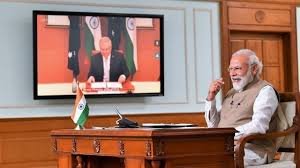
By Rushali Saha Australia has hailed the first virtual summit with India on June 4 as a great success and hopes that it will boost closer cooperation in areas of science and technology, defence and maritime security. The first virtual summit between India’s Prime Minister Narendra Modi and his Australian counterpart Scott Morrison culminated in upgrading bilateral ties to the level of comprehensive strategic partnership. The virtual summit was widely covered by leading Australian media outfits. The China angle dominated the accounts of the talks featured in Australian print and electronic platforms. Famous Sky News host Peter Gleeson said that Australia must “break free of the shackles of our ties with communist China” and instead “embrace new opportunities like India and Indonesia.” Australians are optimistic about the potential that strengthened ties with Australia holds for them as he called India a “country full of promise.” He alluded to India’s democratic credentials and underlined the difference between the “totalitarian regime” in China and a “commonwealth nation.” Following the Summit, The Sydney Morning Herald reported “both countries are attempting to counter rising Chinese influence in the region” and noted China’s recent increase in military presence in South China sea has been “annoying Western nations such as United States and Australia.” The same newspaper had reported on India-China border skirmishes as “despite coronavirus crisis, China flexes muscles on India border.” During the first-ever virtual summit, India and Australia signed a wide-ranging maritime declaration, marking a major step forward in the security and defence relationship and closer coordination in shaping a free and open Indo-Pacific region. As the Indo-Pacific region is becoming the heartland of geopolitical competition, both countries reiterated their commitment to supporting a “rules based maritime order” that is based on “respect for sovereignty and international law.” Apart from this, both countries attach importance to the Indian Ocean as a trade route as a region which is home to some of the most important shipping chokepoints. The importance Australia places on the Indian Ocean is visible in the 2013 Defence White Paper which is considered he first official document to cite “Indo-Pacific.” Australia has previously acknowledged the need to prioritise relations with India, given the natural geographical advantage India has in the Indian Ocean. India and Australia, along with the United States, and Japan are part of the “Quad” arrangement, which brough the two nations closer to each other strategically. Furthermore, during the summit Australia conveyed that “India could consider it as a stable, reliable and trusted supplier of high-quality mineral resources to India” while reiterating its support for India’s candidacy for permanent membership of a reformed UNSC and India’s candidature for a non-permanent seat the UNSC for 2021-22 term. Ahead of the June 4 summit, Purnendra Jain, Adjunct Professor of Asian Studies, University of Adelaide wrote in The Conversation: “While it is unlikely that the “C” word will figure in the talks between Morrison and Modi, China will no doubt loom large in both leaders’ minds” reflecting the general attitude in Australia. As this virtual summit is being hailed as “a new model of India-Australia partnership” and with Trump signalling his intentions to include India and Australia in an expanded G-7, one can expect this partnership to only grow in the future.” (Rushali Saha works Research Intern with India Writes Network) >