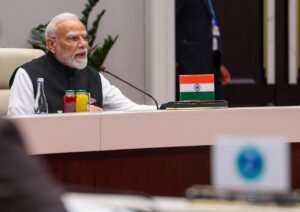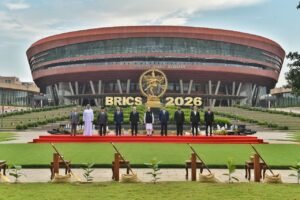
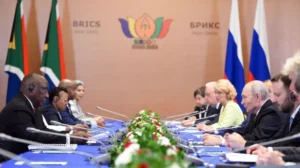
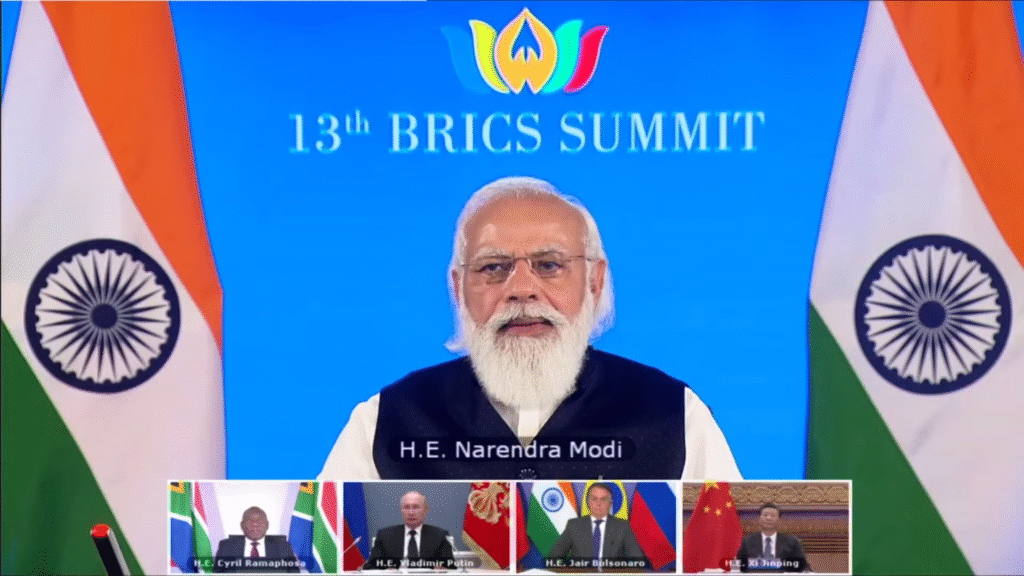
By Shweta Aggarwal Setting the tone for the future of the five-nation grouping of emerging powers, India’s Prime Minister Narendra Modi has called for making the BRICS more result-oriented in the next 15 years as the leaders of five countries adopted a landmark Counter-Terrorism Action Plan. “The BRICS platform has witnessed several achievements in the last one and a half decades,” Mr Modi said at the 13th BRICS summit which marks the 15th anniversary of the grouping. “Today we are an influential voice for the emerging economies of the world. This platform has also been useful for focusing attention on the priorities of developing nations as well,” he said. Alluding to signature institutions created by BRICS, including the New Development Bank, the Contingency Reserve Arrangement and the Energy Research Cooperation Platform, PM Modi cautioned against smugness and raised the bar for this grouping. “These are all very strong institutions. There is no doubt that there is much we can be proud of. However, it is also important that we do not become too self-satisfied and we must ensure that BRICS is even more result oriented in the next 15 years.” 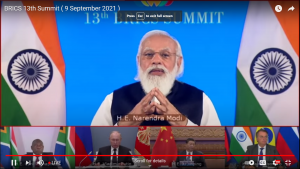 The agenda for the 13th BRICS summit, held under India’s presidency, was adopted virtually by the leaders of five countries, including PM Modi, Chinese President Xi Jinping, Russian President Vladimir Putin, Brazil’s President Jair Bolsonaro and South African President Cyril Ramaphosa. The BRICS leaders adopted the BRICS Counter Terrorism Action Plan and a landmark standalone document on strengthening and reforming the multilateral system. The BRICS counter-terrorism action plan focuses on result-oriented and pragmatic cooperation among the five countries, which will include, among other things, intelligence and information sharing among law enforcement agencies for preventing and combating terrorism; inter-agency cooperation; and sharing of best practices for curbing radicalisation and misuse of the internet by terrorists. The action plan also envisages enhanced cooperation in the growth of illegal drug production and trafficking in the region. In his opening remarks, President Putin focused on the deepening crisis in Afghanistan in the wake of the Taliban takeover of the country and called for enhanced intra-BRICS cooperation in preventing Afghanistan from becoming the hub of terrorism and narcotics. President Ramaphosa exhorted the internatonal community to support TRIPS waiver for enhancing production of anti-Covid-19 vaccines and to facilitate equal global access to global public heath goods.