
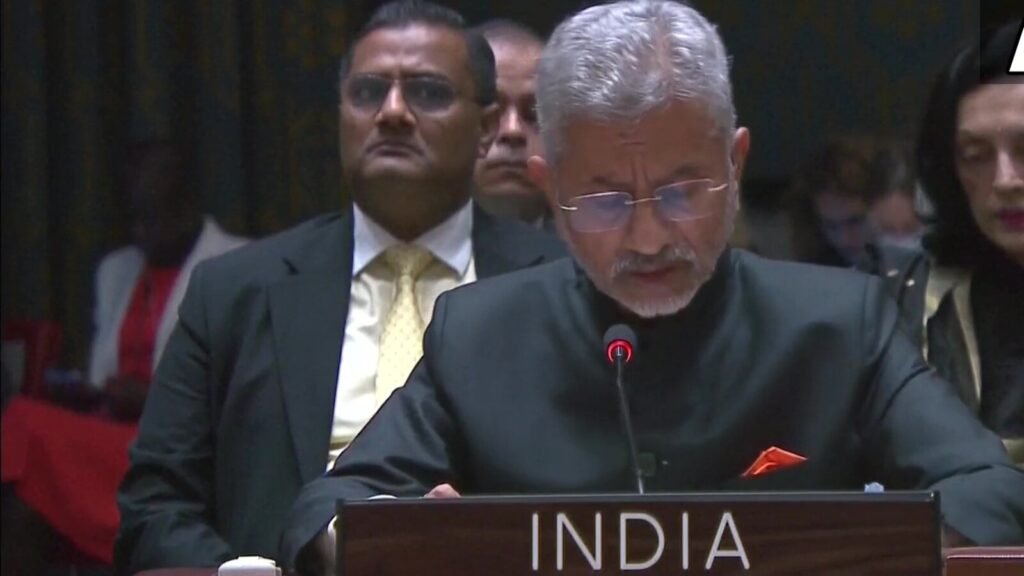
NEW YORK/NEW DELHI: Underlining that the trajectory of the Ukraine conflict is “a matter of profound concern,” India’s External Affairs Minister S. Jaishankar said at a meeting in the United Nations Security Council that “the need of the hour is to end this conflict and return to the negotiating table.” “The need of the hour is to end this conflict in Ukraine and return to the negotiating table. This Council is the most powerful contemporary symbol of diplomacy. It must continue to live up to its purpose,” Mr Jaishankar told the meeting in the UNSC on the Ukraine crisis on September 22. A day after Russian President Vladimir Putin announced a partial mobilisation of 300,000 potential combatants and a threat of nuclear action, Mr Jaishankar called for upholding ruled-based global order and respect for the territorial integrity and sovereignty of all States. “These principles too must be upheld, without exception,” he stressed.
Days after Prime Minister Narendra Modi told Mr Putin that “this cannot be an era of war,” Mr Jaishankar underscored the gravitas of the situation by using expressions like “profound concerns,” “disturbing” and “anxiety” to convey India’s growing wariness with the escalation of the Ukraine conflict. “The trajectory of the Ukraine conflict is a matter of profound concern for the entire international community. The future outlook appears even more disturbing.” “The nuclear issue is a particular anxiety,” he said while alluding to the risk of damage to the Zaporizhzhia nuclear power plant at risk of damage.
Pain of Global South Highlighting the pain of the global south and the impact of the Ukraine crisis on food and fuel prices, the minister called “for an immediate cessation of all hostilities and a return to dialogue and diplomacy.” “In a globalized world, the impact of the conflict is being felt even in distant regions. We have all experienced its consequences in terms of surging costs and actual shortages of foodgrains, fertilizers and fuel. On this score too, there are good grounds to be worried about what awaits us.” “The global south, especially, is feeling the pain very acutely,” he said. We must therefore not initiate measures that further complicate the struggling global economy and that is why India strongly reiterates the need for an immediate cessation of all hostilities and a return to dialogue and diplomacy. On our part, we are also providing both humanitarian assistance to Ukraine and economic support to some of our neighbours under economic distress. The minister took a strong stand on the humanitarian crisis unfolding in Ukraine and stressed that “even in conflict situations, there can be no justification for violation of human rights or of international law.” “Where any such acts occur, it is imperative that they are investigated in an objective and independent manner.” This was the position we took with regard to the killings in Bucha and this is the position we take even today. The Council will also recall that we had then supported calls for an independent investigation into the Bucha incident. China’s ‘Impunity’
In his statement, Mr Jaishankar also took a veiled but obvious swipe at China’s rejection of a proposal to designate Maki as an international terrorist. “Politics should never ever provide cover to evade accountability. Nor indeed to facilitate impunity.”
“Regrettably, we have seen this of late in this very Chamber, when it comes to sanctioning of some of the world’s most dreaded terrorists. If egregious attacks committed in broad daylight are left unpunished, this Council must reflect on the signals we are sending on impunity.” He was referring to China’s recent hold on a US-India proposal to sanction Pakistan-based LeT terrorist Sajid Mir at the UNSC’s 1267 Al-Qaeda Sanctions Committee. “There must be consistency if we are to ensure credibility,” said Mr Jaishankar.