Published by TGII Media Private Limited, a leading media, publishing, research, and consultancy company, India and The World (ITW) is one of its kind magazine and journal that is exclusively focused on international affairs. ITW publishes long–form essays, commentaries and interviews with eminent personalities, iplomats and strategy gurus from India and the World. Marrying high–quality content and innovative design, ITW has acquired a devoted following among the diplomatic and strategic community
Published by TGII Media Private Limited, a leading media, publishing, research, and consultancy company, India and The World (ITW) is one of its kind magazine and journal that is exclusively focused on international affairs. ITW publishes long–form essays, commentaries and interviews with eminent personalities, iplomats and strategy gurus from India and the World. Marrying high–quality content and innovative design, ITW has acquired a devoted following among the diplomatic and strategic community
Published by TGII Media Private Limited, a leading media, publishing, research, and consultancy company, India and The World (ITW) is one of its kind magazine and journal that is exclusively focused on international affairs. ITW publishes long–form essays, commentaries and interviews with eminent personalities, iplomats and strategy gurus from India and the World. Marrying high–quality content and innovative design, ITW has acquired a devoted following among the diplomatic and strategic community
Published by TGII Media Private Limited, a leading media, publishing, research, and consultancy company, India and The World (ITW) is one of its kind magazine and journal that is exclusively focused on international affairs. ITW publishes long–form essays, commentaries and interviews with eminent personalities, iplomats and strategy gurus from India and the World. Marrying high–quality content and innovative design, ITW has acquired a devoted following among the diplomatic and strategic community
The current flux and disorder in the international order have also infected India’s neighbourhood. In Bangladesh and Nepal, domestic political developments led to regime change. Bangladesh sank into a political-economic quagmire, after the ouster of Sheikh Hasina’s government in August 2024. The current turmoil in Bangladesh has damaged India’s friendly and economically productive relations with a close partner. India’s “Neighbourhood First” policy faces new geopolitical and geoeconomic challenges.
Sheikh Hasina had annoyed both the US and Pakistan. She refused to submit to American demands for facilitating a military base on St Martin’s Island and the so-called “Humanitarian Corridor”, to pump in arms into Myanmar to help rebels fighting the ruling Military Junta. Pakistan was unhappy because Hasina took strong steps to curb radical Islamic organizations and thwarted Pakistan’s objectives of using Bangladesh for terrorist and criminal activities against India. The US and Pakistan collaborated to leverage the students’ agitation to oust Hasina. The Jamaat-e-Islami [JeI], Pakistan’s fifth column and its youth wing the Shibir, provided the storm troopers for the agitation. US NGOs injected funds and guidance. The US has maintained close links with JeI, arguing that it is better to engage them to ensure they remain in the mainstream and become less radical and extremist. Arguably, the exit of an India-friendly government helps to constrain India and further the geopolitical objectives of the two countries.Radicalisation and Intolerance
The Interim Government [IG] imposed on Bangladesh is universally regarded as lacking in legitimacy. It is headed by Prof Muhammad Yunus, a Nobel Peace Prize awardee in 2026. Under his watch, Bangladesh has found peace elusive. The IG has presided over attacks on civil society activists, cultural institutions, academics, teachers, the media, the media, Hindu community leaders and anyone holding liberal and secular values. Many have been summarily arrested and dumped in prison, without recourse to bail.
Awami League [AL] leaders and workers have been hunted down and killed and their properties destroyed. Many AL leaders and workers have sought refuge in India. These attacks are organized by Islamists, led by the pro-Pakistan Jamaat-e-Islami [JeI], the largest Islamist organization. Revenge is the primary motivation. Under the Yunus regime’s patronage, the JeI and other radical Islamist groups have aggressively captured institutions and dictated terms to the IG. The military and the police have become mute bystanders. Bangladesh is increasingly becoming more Islamist, less secular and increasingly intolerant.
Anti-India Campaign
Hindus and other non-Muslim minorities have been frequently attacked and killed brutally. The Yunus regime has adopted a deliberate denial mode, despite a flood of evidence in the social media. Yunus’ puerile advocacy that killings and violence against Hindus, as stray acts by fringe elements and calling them “political” and “not communal”, is seen as dodging responsibility. Orchestrated mobs have also attacked India’s High Commission in Dhaka and Consulates in Chittagong, Khulna, Rajshahi and Sylhet, compelling India to temporarily stop issue of visas. These attacks have inflamed Indian public opinion.
Predictably, the Yunus regime’s attitude towards India has been marked by hostility, shaped by its alliance with Islamist forces and pathological hatred of Hasina. India’s warm relations with the Hasina government, her seeking refuge in India, imposition of the death sentence by a manipulated trial in a kangaroo court and India ignoring extradition demands, has been exploited to fuel anti-India rhetoric. Fanning anti-India sentiments to deflect poor governance has been the preferred tactic under the Yunus regime. Hasina’s public criticism of Yunus, blaming him for empowering extremist elements, stoking anti-India sentiment and weakening democratic structures and endangering both domestic stability and regional security, has irked the Yunus regime further.
Pakistan’s Insidious Agenda
Pakistan has gone into overdrive to mount a strenuous effort to exert influence, build an anti-India narrative and strengthen its lobbies in Bangladesh. The frequent visits of Pakistani military and ISI officials, revival of military ties with Pakistan, joint defence outreach with China and supporting an alternate SAARC minus India have reinforced perceptions of Dhaka opting to join the anti-India axis. Pakistan’s Army Chief and Field Marshal Asim Munir has even threatened India with retribution from the “East”. A defence pact with Pakistan, supply of Chinese fighter aircraft and military equipment are on the anvil.
Anti-India rhetoric reached a peak when a student leader threatened to occupy India’s eastern states adjacent to Bangladesh and provide sanctuary and assistance to Indian insurgents. It reflects a well-planned effort to encourage anti-India sentiments and fan the flames of hardened nationalist rhetoric among the youth. The death of a young anti-Hasina agitation leader, a cultural activist, founder of the Inqilab Manch and a rabble rouser, known for spewing virulent hatred against the Awami League [AL] and India, sparked another round of violence. Mobs shouting anti-India and Islamic slogans burned down and looted the buildings of two leading newspapers – Prothom Alo and The Daily Star. The building of Chhayanaut, the leading cultural organization, suffered the same fate.
Earlier, the Islamists demanded cancellation of appointments for music and physical training teacher in schools, labelling them un-Islamic. The Yunus regime meekly complied. Islamists have declared war on Bangladesh’s premier institutions, destroying government buildings, archives, museums and houses of the country’s towering leader Sheikh Mujibur Rahman, to erase his legacy and re-write history. The Chhayanaut attack and the one on Udichi, another famous cultural platform, are part of that campaign to impose Islamic values, eliminate Bengali culture, rewrite history and wipe out the memory of the 1971 War of Liberation. The Islamists consider all aspects of Bengali culture as un-Islamic and want to wipe out the memory of opposing the independence of Bangladesh to influence the younger generation.
Anti-India mood was further inflamed after social media was flooded with allegations that the alleged killers had fled to India. Pakistan’s Inter-Services Intelligence (ISI) fanned the anti-India narrative. Via social media. Police investigation failed to produce any evidence and now the police have claimed that the killers fled to Meghalaya. India has rejected this claim. The dead leader’s brother has continued the agitation to demand justice and demanded that all Indians be expelled from Bangladesh. Rumours are rampant about the killing being organized by JeI to cause chaos and force postponement of the elections. The alleged killer has surfaced in video clips, claiming to be in Dubai asserting his innocence. It is being alleged that the Yunus-JeI regime helped him escape.
India’s protests on the killing of Hindus and counter protests by Indians near Bangladeshi Missions at Delhi, Kolkata and Agartala, have led to led to another round of testy diplomatic exchanges between Delhi and Dhaka. Bangladeshi Islamist mob attacks are a virulent expression of an ideological affliction, fuelled by religious frenzy and historical amnesia. The ethnic cleansing of Hindus that began with the Partition, continued during the East Pakistan period. It spiked massively during the 1965 and 1971 Wars. After Bangladesh was created, the migration of Hindus continued sporadically. Bangladesh’s Hindu population has dwindled to 8 per cent from a high of 30% in erstwhile East Bengal.
Return of Tarique Rahman
Political upheavals are not new in Bangladesh. There have been several since its independence in 1971. Elections have been scheduled in February 2026, 17 months after the IG took over. The people of Bangladesh are looking forward to casting their vote, hopefully in a free, fair, inclusive and credible elections. As Bangladesh heads towards election in February 2026, the Bangladesh Nationalist Party’s [BNP] acting chairman Tarique Rahman returned to Dhaka, ending more than 17 years of forced exile in the UK. His arrival is likely to galvanize the BNP and improve better its chance in the elections.
The demise of Khaleda Zia, hospitalized for over two months, is likely to swing some sympathy votes towards the BNP. In case of a hung Parliament, a coalition government with JeI and NCP is a possibility, with Tarique Rahman as PM. A fractious coalition government will have its own problems. Tarique bears the burden of a negative historical baggage. He was convicted in numerous corruption and terrorism-related cases. The Yunus regime has hurriedly arranged his acquittal in all cases by a compliant judiciary, installed by the Yunus regime.
The possibility of a deal between Tarique and Yunus cannot be ruled out. Nor can we rule out the green signal from the Ameircans, backing the deal. The Americans had a very poor view of Tarique, laid bare in classified cables from the American embassy in Dhaka. In one cable he has been called a “Dark Prince”. His legendary extortion from business houses and amassing huge wealth, parked abroad is well documented. His collaboration with Pakistan’s ISI for arms smuggling for the Indian Insurgents Groups [IIGs], like the ULFA, is also well known. The AL also labelled him a “convicted criminal” and trashed the deal as a “back door” one.
Tarique’s public statements have been carefully crafted to address public opinion and make him sound like a statesman. He has advocated that he will give the highest priority to Bangladesh’s national interests. On relations with India, he has aligned to public sentiments by raising the issue of water sharing and killings on the border.
On Hasina taking refuge in India, he said in an interview: “If they now choose to shelter a dictator and thus earn the resentment of the people of Bangladesh, then there is nothing we can do about that, ….The people of Bangladesh have decided that relations will remain cool. So, I have to stand with my country’s people.” This public posture may not be etched in granite since Tarique and his advisers have reached out to Delhi for support, promising a new beginning. There will be pressure from the US, Pakistan and China to cool links with India and navigating these pressures will be a foreign policy challenge for the new government in Dhaka.
The JeI, the BNP’s erstwhile coalition partner, has branched out independently after the success of the regime change operation. The JeI has negotiated a seat sharing agreement with the National Citizens Party (NCP). The JeI-NCP electoral understanding has led to over 30 leading members the NCP to quit. Some may fight the elections as independents while some may join the BNP. The stigma of association with the JeI is still quite strong. The NCP has failed to develop any traction in the country and a coalition with the JeI may help. The JeI sees the current situation in Bangladesh as the best-ever opportunity to make a grab for power. The JeI-NCP coalition will be the main opposition to the BNP. The Awami Leage [AL] has been banned and cannot participate in the election. India expects free, fair and inclusive polls. Without the Awami League’s participation, the elections will lack credibility. Yunus and his cohorts accused Hasina of manipulating elections and labelled her a “fascist dictator”. Ironically, Yunus has adopted the same tactic.
India’s Dilemma
India’s reaction to developments in Bangladesh has been marked by strategic restraint, hoping that the forthcoming election will lead to political stability and a more productive engagement with an elected government. There will be a recalibration of policy since there are compelling geopolitical factors related to the policies adopted by Pakistan, US and China. PM Modi’s condolence message on Khaleda’s demise and External Affairs Minister S. Jaishankar attending her funeral are signals that convey India’s willingness to work with the new government, leaving the past behind. While Khaleda made choices that treated India as a “frenemy”, the world has moved on. Tarique has had 17 years in exile to ponder over his own future and India-Bangladesh ties.
India will not abandon its “Neighbourhood First” policy that believe a peaceful, democratic, politically stable and economically integrated neighbourhood best serves India’s long-term national interests. Yet, the overhang of history, geography and asymmetry complicates India’s relations with its neighbours, often breeding mistrust. India’s core dilemma is how to promote bilateral ties with neighbours, support stability when political volatility diverts attention from its core goals of fostering regional prosperity amid challenges of terrorism, religious radicalism, illegal migration, historical grievances and environmental stress. India’s security interests cannot be ignored while pursuing these objectives. Bangladesh will have to factor in the consequences of adopting policies like that of Pakistan towards India. Hence, Bangladesh’s trajectory remains crucial given the geographical connect, trade interdependence and security overhang in India’s eastern theatre.
(Pinak Ranjan Chakravartyserved as Secretary in India’s Ministry of External Affairs and earlier as Deputy High Commissioner and High Commissioner to Bangladesh. From 2010 to 2011 he served as Ambassador to Thailand and later as Special Secretary (Public Diplomacy, before he was appointed Secretary (Economic Relations) in the MEA.)
(This article has been published in India and the World magazine. To subscribe, write to indiawritesgroup@gmail.com)
Centre for Global India Insights (CGII) is India’s leading foreign policy think tank that focuses on international relations, geopolitics and public policy. In a world fraught with risks , CGII provides in-depth perspectives and decodes larger global trends through independent research and first-hand sources. CGII generates insights into complex global issues and provide actionable policy analysis, research and commentaries to both local and global audiences about India’s multifarious connections with different regions and geographies. Led and driven by a team of distinguished professionals and experts, CGII’s research work is disseminated and amplified through its media and publishing platforms, including India Writes Network and India and the World journal. For more: https://cgiiglobal.org/who-we-are/





Bangladesh Elections: Critical Political Transition, India’s High Stakes
By Pinak Ranjan Chakravarty
The current flux and disorder in the international order have also infected India’s neighbourhood. In Bangladesh and Nepal, domestic political developments led to regime change. Bangladesh sank into a political-economic quagmire, after the ouster of Sheikh Hasina’s government in August 2024. The current turmoil in Bangladesh has damaged India’s friendly and economically productive relations with a close partner. India’s “Neighbourhood First” policy faces new geopolitical and geoeconomic challenges.
The Interim Government [IG] imposed on Bangladesh is universally regarded as lacking in legitimacy. It is headed by Prof Muhammad Yunus, a Nobel Peace Prize awardee in 2026. Under his watch, Bangladesh has found peace elusive. The IG has presided over attacks on civil society activists, cultural institutions, academics, teachers, the media, the media, Hindu community leaders and anyone holding liberal and secular values. Many have been summarily arrested and dumped in prison, without recourse to bail.
Anti-India Campaign
Hindus and other non-Muslim minorities have been frequently attacked and killed brutally. The Yunus regime has adopted a deliberate denial mode, despite a flood of evidence in the social media. Yunus’ puerile advocacy that killings and violence against Hindus, as stray acts by fringe elements and calling them “political” and “not communal”, is seen as dodging responsibility. Orchestrated mobs have also attacked India’s High Commission in Dhaka and Consulates in Chittagong, Khulna, Rajshahi and Sylhet, compelling India to temporarily stop issue of visas. These attacks have inflamed Indian public opinion.
Predictably, the Yunus regime’s attitude towards India has been marked by hostility, shaped by its alliance with Islamist forces and pathological hatred of Hasina. India’s warm relations with the Hasina government, her seeking refuge in India, imposition of the death sentence by a manipulated trial in a kangaroo court and India ignoring extradition demands, has been exploited to fuel anti-India rhetoric. Fanning anti-India sentiments to deflect poor governance has been the preferred tactic under the Yunus regime. Hasina’s public criticism of Yunus, blaming him for empowering extremist elements, stoking anti-India sentiment and weakening democratic structures and endangering both domestic stability and regional security, has irked the Yunus regime further.
Pakistan’s Insidious Agenda
Anti-India rhetoric reached a peak when a student leader threatened to occupy India’s eastern states adjacent to Bangladesh and provide sanctuary and assistance to Indian insurgents. It reflects a well-planned effort to encourage anti-India sentiments and fan the flames of hardened nationalist rhetoric among the youth. The death of a young anti-Hasina agitation leader, a cultural activist, founder of the Inqilab Manch and a rabble rouser, known for spewing virulent hatred against the Awami League [AL] and India, sparked another round of violence. Mobs shouting anti-India and Islamic slogans burned down and looted the buildings of two leading newspapers – Prothom Alo and The Daily Star. The building of Chhayanaut, the leading cultural organization, suffered the same fate.
Earlier, the Islamists demanded cancellation of appointments for music and physical training teacher in schools, labelling them un-Islamic. The Yunus regime meekly complied. Islamists have declared war on Bangladesh’s premier institutions, destroying government buildings, archives, museums and houses of the country’s towering leader Sheikh Mujibur Rahman, to erase his legacy and re-write history. The Chhayanaut attack and the one on Udichi, another famous cultural platform, are part of that campaign to impose Islamic values, eliminate Bengali culture, rewrite history and wipe out the memory of the 1971 War of Liberation. The Islamists consider all aspects of Bengali culture as un-Islamic and want to wipe out the memory of opposing the independence of Bangladesh to influence the younger generation.
Anti-India mood was further inflamed after social media was flooded with allegations that the alleged killers had fled to India. Pakistan’s Inter-Services Intelligence (ISI) fanned the anti-India narrative. Via social media. Police investigation failed to produce any evidence and now the police have claimed that the killers fled to Meghalaya. India has rejected this claim. The dead leader’s brother has continued the agitation to demand justice and demanded that all Indians be expelled from Bangladesh. Rumours are rampant about the killing being organized by JeI to cause chaos and force postponement of the elections. The alleged killer has surfaced in video clips, claiming to be in Dubai asserting his innocence. It is being alleged that the Yunus-JeI regime helped him escape.
Return of Tarique Rahman
Political upheavals are not new in Bangladesh. There have been several since its independence in 1971. Elections have been scheduled in February 2026, 17 months after the IG took over. The people of Bangladesh are looking forward to casting their vote, hopefully in a free, fair, inclusive and credible elections. As Bangladesh heads towards election in February 2026, the Bangladesh Nationalist Party’s [BNP] acting chairman Tarique Rahman returned to Dhaka, ending more than 17 years of forced exile in the UK. His arrival is likely to galvanize the BNP and improve better its chance in the elections.
The demise of Khaleda Zia, hospitalized for over two months, is likely to swing some sympathy votes towards the BNP. In case of a hung Parliament, a coalition government with JeI and NCP is a possibility, with Tarique Rahman as PM. A fractious coalition government will have its own problems. Tarique bears the burden of a negative historical baggage. He was convicted in numerous corruption and terrorism-related cases. The Yunus regime has hurriedly arranged his acquittal in all cases by a compliant judiciary, installed by the Yunus regime.
The possibility of a deal between Tarique and Yunus cannot be ruled out. Nor can we rule out the green signal from the Ameircans, backing the deal. The Americans had a very poor view of Tarique, laid bare in classified cables from the American embassy in Dhaka. In one cable he has been called a “Dark Prince”. His legendary extortion from business houses and amassing huge wealth, parked abroad is well documented. His collaboration with Pakistan’s ISI for arms smuggling for the Indian Insurgents Groups [IIGs], like the ULFA, is also well known. The AL also labelled him a “convicted criminal” and trashed the deal as a “back door” one.
On Hasina taking refuge in India, he said in an interview: “If they now choose to shelter a dictator and thus earn the resentment of the people of Bangladesh, then there is nothing we can do about that, ….The people of Bangladesh have decided that relations will remain cool. So, I have to stand with my country’s people.” This public posture may not be etched in granite since Tarique and his advisers have reached out to Delhi for support, promising a new beginning. There will be pressure from the US, Pakistan and China to cool links with India and navigating these pressures will be a foreign policy challenge for the new government in Dhaka.
The JeI, the BNP’s erstwhile coalition partner, has branched out independently after the success of the regime change operation. The JeI has negotiated a seat sharing agreement with the National Citizens Party (NCP). The JeI-NCP electoral understanding has led to over 30 leading members the NCP to quit. Some may fight the elections as independents while some may join the BNP. The stigma of association with the JeI is still quite strong. The NCP has failed to develop any traction in the country and a coalition with the JeI may help. The JeI sees the current situation in Bangladesh as the best-ever opportunity to make a grab for power. The JeI-NCP coalition will be the main opposition to the BNP. The Awami Leage [AL] has been banned and cannot participate in the election. India expects free, fair and inclusive polls. Without the Awami League’s participation, the elections will lack credibility. Yunus and his cohorts accused Hasina of manipulating elections and labelled her a “fascist dictator”. Ironically, Yunus has adopted the same tactic.
India’s Dilemma
India will not abandon its “Neighbourhood First” policy that believe a peaceful, democratic, politically stable and economically integrated neighbourhood best serves India’s long-term national interests. Yet, the overhang of history, geography and asymmetry complicates India’s relations with its neighbours, often breeding mistrust. India’s core dilemma is how to promote bilateral ties with neighbours, support stability when political volatility diverts attention from its core goals of fostering regional prosperity amid challenges of terrorism, religious radicalism, illegal migration, historical grievances and environmental stress. India’s security interests cannot be ignored while pursuing these objectives. Bangladesh will have to factor in the consequences of adopting policies like that of Pakistan towards India. Hence, Bangladesh’s trajectory remains crucial given the geographical connect, trade interdependence and security overhang in India’s eastern theatre.
(Pinak Ranjan Chakravarty served as Secretary in India’s Ministry of External Affairs and earlier as Deputy High Commissioner and High Commissioner to Bangladesh. From 2010 to 2011 he served as Ambassador to Thailand and later as Special Secretary (Public Diplomacy, before he was appointed Secretary (Economic Relations) in the MEA.)
(This article has been published in India and the World magazine. To subscribe, write to indiawritesgroup@gmail.com)
CGII Network
Related Posts
Diplomatic win for India: BRICS bridges Gulf divide, bats for Global South
Illuminating India’s BRICS moment
With Trump listening in, Iran urges PM Modi to end war with US
India Russia ‘dosti’ in Bishkek: Focus on end of Ukraine war, balanced trade
Uncovering Pakistan: Modi rallies SCO against states that use terror as policy
Modi’s SCO agenda: Shaping a region free of terror, widening arc of prosperity
Latest Events
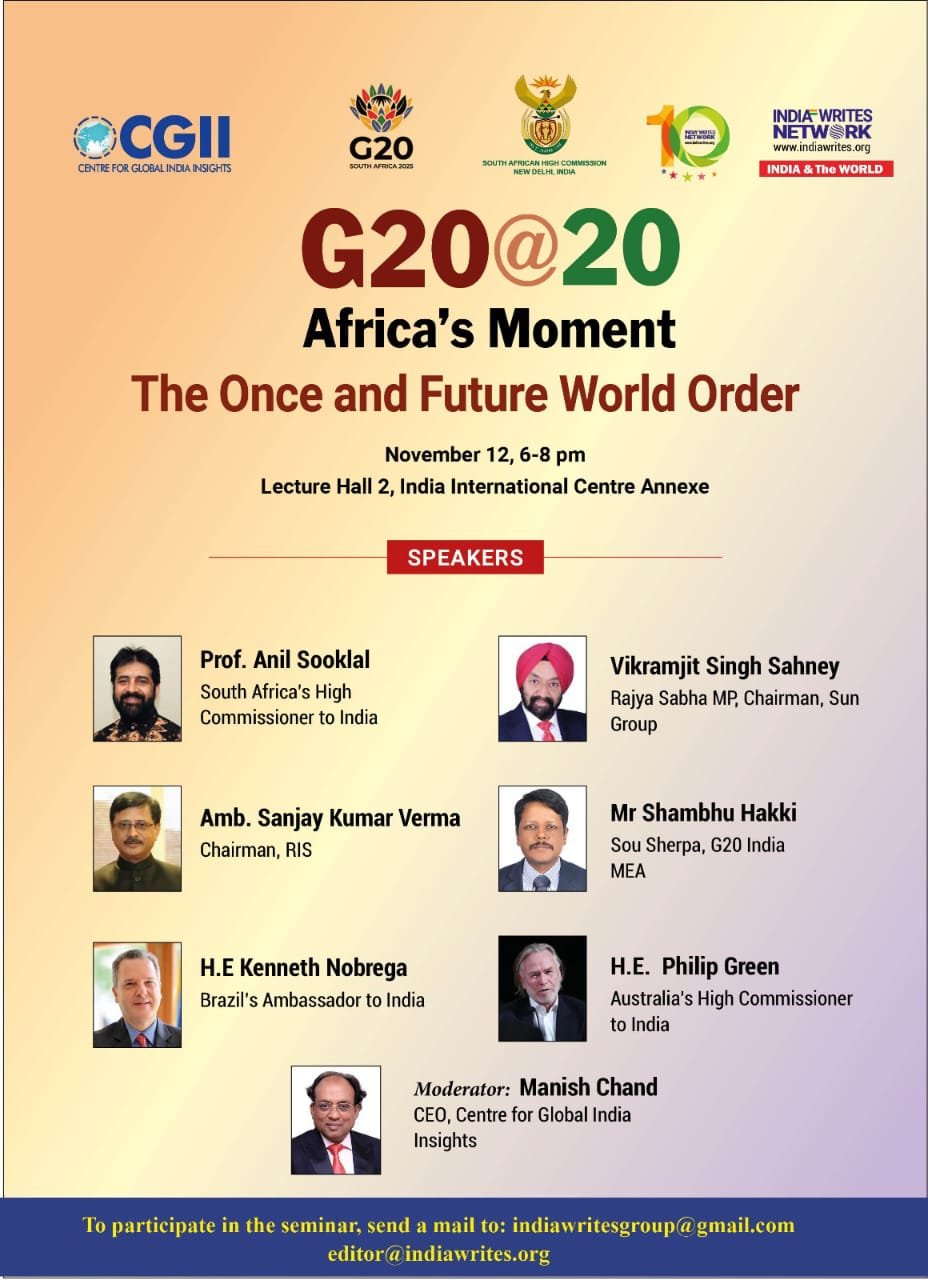
G20@20: Africa’s Moment – The Once and Future World Order
Speakers
Professor Anil Sooklal
Kenneth da Nobrega
Manish Chand
Ambassador Philip Green
Sanjay Kumar Verma
Shambhu Hakki
Vikramjit Singh Sahney
MPs, diplomats laud Operation Sindoor, call for national unity to combat Pakistan-sponsored terror
Speakers
Aparajita Sarangi
Brij Lal
Dr Amar Patnaik
Manish Chand
Priyanka Chaturvedi
Sujan Chinoy
Yashvardhan Kumar Sinha
BRICS summit in Rio to focus on Global South, local currency trade
Speakers
Dammu Ravi
Denis Alipov
Ina Hagniningtyas Krisnamurthi
Jyoti Vij
Kamel Zayed Kamel Galal
Kenneth da Nobrega
Manish Chand
Book
India’s G20 Legacy: Shaping a New World Order
Editor: Manish Chand
Pages: 206
Publisher: Pentagon Press LLP
Cover Price: INR 995
In Conversation
India’s BRICS Chairship Critical for Global South: South Africa’s Envoy
In The Press
Rescuing G20 from North-South divide: Ubuntu Moment
The Sunday Guardian: India calls for strengthened BRICS cooperation
Daily Excelsior: Ahead BRICS summit in Rio, envoys call for greater focus on combating terrorism
Rediff: BRICS Summit 2024: Focus on National Currencies
Latest From CGII
Diplomatic win for India: BRICS bridges Gulf divide, bats for Global South
Illuminating India’s BRICS moment
With Trump listening in, Iran urges PM Modi to end war with US
India Russia ‘dosti’ in Bishkek: Focus on end of Ukraine war, balanced trade
Uncovering Pakistan: Modi rallies SCO against states that use terror as policy
Modi’s SCO agenda: Shaping a region free of terror, widening arc of prosperity
The Journal
Special Edition on India’s Indo-Pacific plus Diplomacy
India’s G20 Journey – Scaling A New Summit