Published by TGII Media Private Limited, a leading media, publishing, research, and consultancy company, India and The World (ITW) is one of its kind magazine and journal that is exclusively focused on international affairs. ITW publishes long–form essays, commentaries and interviews with eminent personalities, iplomats and strategy gurus from India and the World. Marrying high–quality content and innovative design, ITW has acquired a devoted following among the diplomatic and strategic community
Published by TGII Media Private Limited, a leading media, publishing, research, and consultancy company, India and The World (ITW) is one of its kind magazine and journal that is exclusively focused on international affairs. ITW publishes long–form essays, commentaries and interviews with eminent personalities, iplomats and strategy gurus from India and the World. Marrying high–quality content and innovative design, ITW has acquired a devoted following among the diplomatic and strategic community
Published by TGII Media Private Limited, a leading media, publishing, research, and consultancy company, India and The World (ITW) is one of its kind magazine and journal that is exclusively focused on international affairs. ITW publishes long–form essays, commentaries and interviews with eminent personalities, iplomats and strategy gurus from India and the World. Marrying high–quality content and innovative design, ITW has acquired a devoted following among the diplomatic and strategic community
Published by TGII Media Private Limited, a leading media, publishing, research, and consultancy company, India and The World (ITW) is one of its kind magazine and journal that is exclusively focused on international affairs. ITW publishes long–form essays, commentaries and interviews with eminent personalities, iplomats and strategy gurus from India and the World. Marrying high–quality content and innovative design, ITW has acquired a devoted following among the diplomatic and strategic community
Published by TGII Media Private Limited, a leading media, publishing, research, and consultancy company, India and The World (ITW) is one of its kind magazine and journal that is exclusively focused on international affairs. ITW publishes long–form essays, commentaries and interviews with eminent personalities, iplomats and strategy gurus from India and the World. Marrying high–quality content and innovative design, ITW has acquired a devoted following among the diplomatic and strategic community
Published by TGII Media Private Limited, a leading media, publishing, research, and consultancy company, India and The World (ITW) is one of its kind magazine and journal that is exclusively focused on international affairs. ITW publishes long–form essays, commentaries and interviews with eminent personalities, iplomats and strategy gurus from India and the World. Marrying high–quality content and innovative design, ITW has acquired a devoted following among the diplomatic and strategic community
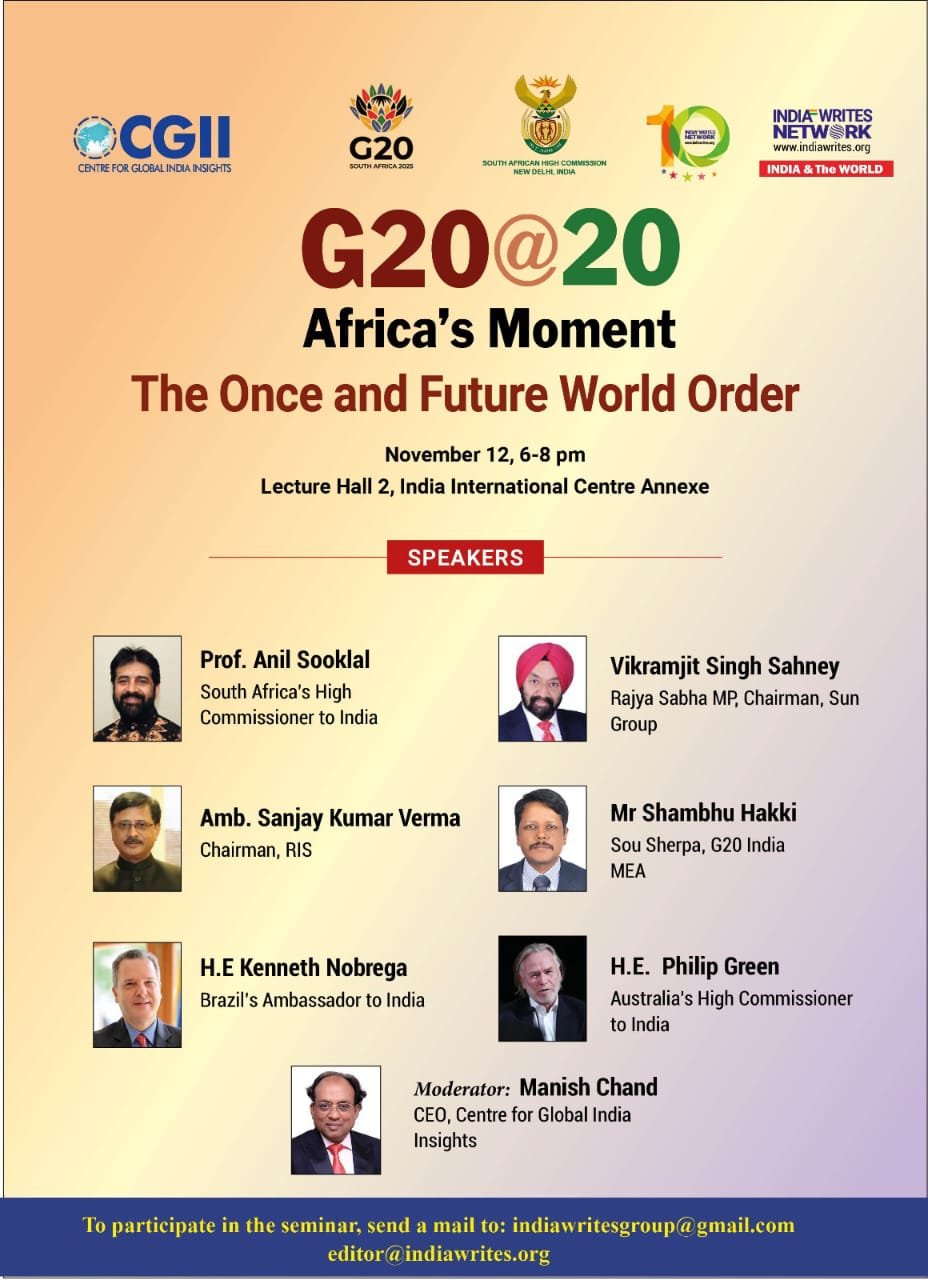
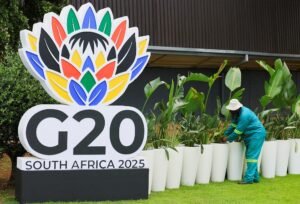
At a time when the world stands at a crossroads — marked by shifting power centres, contested global norms, and calls for inclusion — the conference titled “G20@20: Africa’s Moment – The Once and Future World Order” brought together eminent diplomats, scholars, and policymakers to reflect on the role of the G20 in shaping international governance. Organized by Centre for Global India Insights (CGII), the South African High Commission, and India Writes Network, the panel discussion was held just ahead of the G20 summit in Johannesburg on November 22-23, 2025.
At a time when the world stands at a crossroads — marked by shifting power centres, contested global norms, and calls for inclusion — the conference titled “G20@20: Africa’s Moment – The Once and Future World Order” brought together eminent diplomats, scholars, and policymakers to reflect on the role of the G20 in shaping international governance. Organized by Centre for Global India Insights (CGII), the South African High Commission, and India Writes Network, the panel discussion was held just ahead of the G20 summit in Johannesburg on November 22-23, 2025.
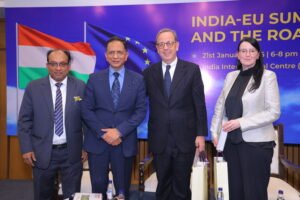
Eminent speakers who participated in the panel discussion at the India International Centre, New Delhi, on November 12 included Prof. Anil Sooklal, South Africa’s High Commissioner to India; Vikramjit Singh Sahney, Rajya Sabha MP, and Chairman, Sun Group; Shambhu Hakki, Sou Sherpa, G20 India; Peter Green, Australia’s High Commissioner to India; and Kenneth Nobrega, Brazil’s Ambassador to India.
Moderated by Manish Chand, CEO, CGII, the session explored Africa’s growing role in global governance, the evolution of the G20 as a bridge between developed and developing worlds, and the shared priorities shaping the grouping’s future amid deepening geopolitical divides.
Reinforcing Multilateralism and Continuity
Speakers reflected on the G20’s trajectory since its elevation to the leaders’ level during the 2008 financial crisis, emphasizing how it became, in Ambassador Anil Sooklal’s words, “a force for global good — at a time when the international community needed a collective platform of the major countries of the Global South and North coming together under one umbrella.”
Recounting the grouping’s origins, Sooklal traced how the first five summits — in Washington, London, Pittsburgh, Toronto, and Seoul — exemplified the political will that stabilized the global economy. The G20, he said, was “not there to replace the multilateral system but to reinforce it at a time when it needed reinforcement from the outside.” Over the years, its agenda has naturally broadened to address “economic, financial, and social challenges” and the growing fault lines of global governance.
In a pointed critique of the US boycott of the Johannesburg summit, Prof. Sooklal said that although it has created “a new challenge” for South Africa’s G20 presidency, “the G20 is too big to fail.”
“For the first time in the history of the G20, when South Africa took over the chair on the first of December last year and announced the theme of our presidency as well as our key priorities, we had a key G20 member totally disown the theme and not support it. It has never happened before,” he said. “We may face challenges, but I firmly believe the G20 remains a powerful force —the only platform, given the weaknesses of the global multilateral system, that bridges the North and South.”
Looking ahead, Prof. Sooklal voiced hopeful about the future of G20. “My view is that the G20 is too big to fail. The UN has had a turbulent past two decades, but it continues because we believe in it. It is our organization, where we have an equal voice and a platform to discuss challenges collectively.”
The panel acknowledged that political crises, from Syria to Ukraine and Gaza, have repeatedly tested the G20’s ability to reach consensus. Yet Sooklal underscored that even amid differences on critical issues, members have “been able to find common ground for global good.” The forum’s endurance, he argued, lies in its coherence and continuity: “The G20 is not about each presidency starting anew. It builds on previous presidencies and the successes we have had.”
South Africa’s presidency, closing the first cycle of four consecutive Global South hosts — Indonesia, India, Brazil, and itself — thus aims not to reinvent the agenda but to consolidate it. Priorities such as inclusive growth, inequality, unemployment, industrialization, and food security will be pursued “through an African lens,” while new task forces will address inequality, critical minerals, and disaster resilience.
Confronting Inequality and Debt
A defining feature of South Africa’s G20 presidency is its focus on inequality and debt sustainability. President Cyril Ramaphosa’s establishment of an Extraordinary G20 Panel of Experts on Global Inequality, chaired by Nobel laureate Joseph Stiglitz, has already produced a landmark report. Citing its findings, Sooklal noted that “between 2000 and 2024, 80 percent of countries globally have high inequality… the wealthiest one percent of the global population accumulated 41 percent of new wealth.”
The report also warned that “one in four persons globally suffers from moderate to severe food insecurity” and that post-COVID, “335 million have been pushed into poverty — including 100 million Africans.” For South Africa, these realities place Africa’s development and Agenda 2063 at the heart of its G20 agenda.
Debt sustainability is being reactivated as a major policy track. Building on the framework initiated under the Saudi presidency, Ramaphosa has appointed former finance minister Trevor Manuel to lead an expert group on African debt. Its work, Sooklal explained, feeds directly into the G20 finance track. Despite signs of growing polarization, he cautioned against pessimism, insisting that “the G20 is too big to fail. It remains the only platform that bridges the North and South.”
Laying out the canvas, Manish Chand, CEO, CGII, called for more proactive response in addressing global crises. “As a new world order emerges, the world will have to deal with interlocking emergencies – climate emergency, financial emergency and inequality emergency,” said Chand, CEO, CGII. “We need to find a new vocabulary of optimism and renewal to navigate this complex and conflicted world, and this is where the G20 summit in Johannesburg matters,” he said.
“Over the last few years, the G20 has moved beyond the economic realm to expand its canvas to include geopolitical crises and hotspots. With multilateralism under stress and the UN system increasingly seen as ineffectual, the G20 has become the go-to place for addressing global crises and challenges,” he said.
Lessons from India’s Presidency
Invoking India’s experience during its G20 presidency in 2023, Shambhu Hakki, India’s G20 Sous-Sherpa, described how India had sought to make the grouping more inclusive through citizen engagement. The “Jan Bhagidari” approach, he explained, transformed the G20 “from a forum of governments into a people’s movement,” with more than 200 events across 60 cities.
India’s initiatives during its presidency, including LiFE (Lifestyle for Sustainable Development), Digital Public Infrastructure, the Coalition for Disaster Resilient Infrastructure, and the Global Biofuel Alliance, were identified as instruments that advanced equitable growth while bridging technological divides.
Mr Hakki reaffirmed India’s support for South Africa’s four priorities: disaster resilience, debt sustainability for low-income countries, financing just energy transitions, and harnessing critical minerals for inclusive growth. “Over 50 economies now spend more than ten percent of public revenues on interest payments,” he warned, emphasizing the need for coordinated reform.
He added that India’s presidency had strengthened the institutional foundation for South Africa’s term, particularly through the African Union’s admission as a permanent G20 member — a step that, in his view, significantly enhanced the legitimacy of the forum.
Terming the Johannesburg summit as “a proud moment for Africa and for South Africa,” Mr Hakk pledged India’s support for core priorities of South Africa’s G20 presidency. Alluding to PM Modi’s visit to South Africa to participate in the G20 summit, Mr Hakki highlighted India’s role as a consensus-builder in a world riven by crises and said that New Delhi will play a proactive role in advancing interests of the Global South. “We are hopeful that together we will be able to deliver ambitious outcomes for the Global South in the upcoming G20 Leaders’ Summit,” he said.
“Most of global growth today is driven by the Global South. The G20 should remain sensitive to the issues and barriers faced by developing countries,” he said. Looking ahead, Mr Hakki said that India will continue to amplify the cause of the Global South in the next cycle of presidencies as well.
Bridging Governance Deficit
Australia’s High Commissioner Philip Green offered a perspective shaped by his experience at the London and Pittsburgh Summits during the 2008 crisis. He recalled leaders “sitting around a small table at Number 10 Downing Street — close enough that it was difficult to read from notes.” That physical proximity, he observed, created “a sense of shared crisis and connective tissue between the world’s major players.”
Today’s crises — climate change, inequality, digital disruption — are no less consequential but have lost that sense of immediacy and cohesion. Mr Green cautioned that the world faces “a deficit in global governance” and urged leaders to focus less on legitimacy and more on capability — on whether grouping such as the G20 “can actually deal with the real and present problems we all face.”
He welcomed South Africa’s emphasis on preserving the global trading system while reforming multilateral institutions like the WTO. He also called for a revival of the 2014 Brisbane consensus on gender equality and women’s economic empowerment, arguing that inclusivity must remain central to global recovery.
Africa’s Economic Frontier
The Johannesburg Summit is expected to draw attention to Africa’s expanding economic horizons. Business leader and parliamentarian Dr. Vikramjit Singh Sahney described the “the first G20 Summit of world leaders on African soil” — a milestone completing the first cycle of summits of the world’s major economies. Africa, he said, represents “a continent of hope, dynamism, and opportunity.”
Sahney identified the continent’s annual infrastructure financing gap of over $100 billion, as estimated by the African Development Bank, as a central challenge that requires G20 leadership. He highlighted the need to strengthen small and medium enterprises, which “account for only one-third of South Africa’s GDP compared with around half in advanced economies.”
Agriculture, he argued, must also move up the value chain. “While more than half of Africa’s population is engaged in farming, the continent still imports $40–50 billion worth of food annually.” Drawing on his tenure as Chair of the BRICS Agribusiness Council, he recalled the establishment of the BRICS Seed Development Bank and urged greater public–private collaboration in agri-processing, skilling, and sustainable farming. His remarks reinforced a broader consensus that Africa’s economic transformation demands concrete policy action rather than aspirational declarations.
Legitimacy and Future of G20
Ambassador Kenneth Nóbrega of Brazil addressed the question of legitimacy that has often surrounded the G20’s role relative to the United Nations. He acknowledged that this debate remains active within Brazilian diplomacy but noted that the G20’s credibility has deepened as it has come to represent both economic weight and demographic diversity.
Reflecting on institutional evolution, Mr Nóbrega praised South Africa’s presidency for “building on solid multilateral consensus and the key foundations laid by previous presidencies.” He highlighted the “G20@20 Years” initiative as symbolic of the grouping’s maturity and commitment to continuity. He also pointed to the African Union’s accession as a full member under India’s presidency as a “historic step,” one that Brazil intends to build on through the Global Alliance Against Hunger and Poverty and a Task Force on Climate Change. The intertwining of developing and developed economies, he noted, is most visible in the area of critical minerals — a priority for Africa and indispensable for the developed world’s green transition. Mr Nóbrega concluded with Nelson Mandela’s enduring reminder: “It always seems impossible until it’s done.”
Throughout the conference, participants converged on a common theme: the G20’s endurance as a bridge between the Global North and South rests on its continuity, inclusivity, and adaptability. The forum’s ability to withstand political turbulence lies in its shared commitment to cooperation — a principle sustained through four successive Global South presidencies.
South Africa’s stewardship, anchored in the values of solidarity, equality, and sustainability, seeks to consolidate this legacy and project Africa’s voice more prominently within global governance. The Johannesburg Summit thus represents not only a continental milestone but also a reaffirmation of collective agency in an uncertain world — a testament to the conviction, as Mandela once said, that “it always seems impossible until it’s done.”
Centre for Global India Insights (CGII) is India’s leading foreign policy think tank that focuses on international relations, geopolitics and public policy. In a world fraught with risks , CGII provides in-depth perspectives and decodes larger global trends through independent research and first-hand sources. CGII generates insights into complex global issues and provide actionable policy analysis, research and commentaries to both local and global audiences about India’s multifarious connections with different regions and geographies. Led and driven by a team of distinguished professionals and experts, CGII’s research work is disseminated and amplified through its media and publishing platforms, including India Writes Network and India and the World journal. For more: https://cgiiglobal.org/who-we-are/



G20@20: Reimagining Global Order, Spotlight on Global South (Conference Report)
At a time when the world stands at a crossroads — marked by shifting power centres, contested global norms, and calls for inclusion — the conference titled “G20@20: Africa’s Moment – The Once and Future World Order” brought together eminent diplomats, scholars, and policymakers to reflect on the role of the G20 in shaping international governance. Organized by Centre for Global India Insights (CGII), the South African High Commission, and India Writes Network, the panel discussion was held just ahead of the G20 summit in Johannesburg on November 22-23, 2025.
Eminent speakers who participated in the panel discussion at the India International Centre, New Delhi, on November 12 included Prof. Anil Sooklal, South Africa’s High Commissioner to India; Vikramjit Singh Sahney, Rajya Sabha MP, and Chairman, Sun Group; Shambhu Hakki, Sou Sherpa, G20 India; Peter Green, Australia’s High Commissioner to India; and Kenneth Nobrega, Brazil’s Ambassador to India.
Moderated by Manish Chand, CEO, CGII, the session explored Africa’s growing role in global governance, the evolution of the G20 as a bridge between developed and developing worlds, and the shared priorities shaping the grouping’s future amid deepening geopolitical divides.
Reinforcing Multilateralism and Continuity
Speakers reflected on the G20’s trajectory since its elevation to the leaders’ level during the 2008 financial crisis, emphasizing how it became, in Ambassador Anil Sooklal’s words, “a force for global good — at a time when the international community needed a collective platform of the major countries of the Global South and North coming together under one umbrella.”
Recounting the grouping’s origins, Sooklal traced how the first five summits — in Washington, London, Pittsburgh, Toronto, and Seoul — exemplified the political will that stabilized the global economy. The G20, he said, was “not there to replace the multilateral system but to reinforce it at a time when it needed reinforcement from the outside.” Over the years, its agenda has naturally broadened to address “economic, financial, and social challenges” and the growing fault lines of global governance.
In a pointed critique of the US boycott of the Johannesburg summit, Prof. Sooklal said that although it has created “a new challenge” for South Africa’s G20 presidency, “the G20 is too big to fail.”
“For the first time in the history of the G20, when South Africa took over the chair on the first of December last year and announced the theme of our presidency as well as our key priorities, we had a key G20 member totally disown the theme and not support it. It has never happened before,” he said. “We may face challenges, but I firmly believe the G20 remains a powerful force —the only platform, given the weaknesses of the global multilateral system, that bridges the North and South.”
Looking ahead, Prof. Sooklal voiced hopeful about the future of G20. “My view is that the G20 is too big to fail. The UN has had a turbulent past two decades, but it continues because we believe in it. It is our organization, where we have an equal voice and a platform to discuss challenges collectively.”
The panel acknowledged that political crises, from Syria to Ukraine and Gaza, have repeatedly tested the G20’s ability to reach consensus. Yet Sooklal underscored that even amid differences on critical issues, members have “been able to find common ground for global good.” The forum’s endurance, he argued, lies in its coherence and continuity: “The G20 is not about each presidency starting anew. It builds on previous presidencies and the successes we have had.”
South Africa’s presidency, closing the first cycle of four consecutive Global South hosts — Indonesia, India, Brazil, and itself — thus aims not to reinvent the agenda but to consolidate it. Priorities such as inclusive growth, inequality, unemployment, industrialization, and food security will be pursued “through an African lens,” while new task forces will address inequality, critical minerals, and disaster resilience.
Confronting Inequality and Debt
A defining feature of South Africa’s G20 presidency is its focus on inequality and debt sustainability. President Cyril Ramaphosa’s establishment of an Extraordinary G20 Panel of Experts on Global Inequality, chaired by Nobel laureate Joseph Stiglitz, has already produced a landmark report. Citing its findings, Sooklal noted that “between 2000 and 2024, 80 percent of countries globally have high inequality… the wealthiest one percent of the global population accumulated 41 percent of new wealth.”
The report also warned that “one in four persons globally suffers from moderate to severe food insecurity” and that post-COVID, “335 million have been pushed into poverty — including 100 million Africans.” For South Africa, these realities place Africa’s development and Agenda 2063 at the heart of its G20 agenda.
Debt sustainability is being reactivated as a major policy track. Building on the framework initiated under the Saudi presidency, Ramaphosa has appointed former finance minister Trevor Manuel to lead an expert group on African debt. Its work, Sooklal explained, feeds directly into the G20 finance track. Despite signs of growing polarization, he cautioned against pessimism, insisting that “the G20 is too big to fail. It remains the only platform that bridges the North and South.”
Lessons from India’s Presidency
Invoking India’s experience during its G20 presidency in 2023, Shambhu Hakki, India’s G20 Sous-Sherpa, described how India had sought to make the grouping more inclusive through citizen engagement. The “Jan Bhagidari” approach, he explained, transformed the G20 “from a forum of governments into a people’s movement,” with more than 200 events across 60 cities.
India’s initiatives during its presidency, including LiFE (Lifestyle for Sustainable Development), Digital Public Infrastructure, the Coalition for Disaster Resilient Infrastructure, and the Global Biofuel Alliance, were identified as instruments that advanced equitable growth while bridging technological divides.
Mr Hakki reaffirmed India’s support for South Africa’s four priorities: disaster resilience, debt sustainability for low-income countries, financing just energy transitions, and harnessing critical minerals for inclusive growth. “Over 50 economies now spend more than ten percent of public revenues on interest payments,” he warned, emphasizing the need for coordinated reform.
He added that India’s presidency had strengthened the institutional foundation for South Africa’s term, particularly through the African Union’s admission as a permanent G20 member — a step that, in his view, significantly enhanced the legitimacy of the forum.
Terming the Johannesburg summit as “a proud moment for Africa and for South Africa,” Mr Hakk pledged India’s support for core priorities of South Africa’s G20 presidency. Alluding to PM Modi’s visit to South Africa to participate in the G20 summit, Mr Hakki highlighted India’s role as a consensus-builder in a world riven by crises and said that New Delhi will play a proactive role in advancing interests of the Global South. “We are hopeful that together we will be able to deliver ambitious outcomes for the Global South in the upcoming G20 Leaders’ Summit,” he said.
“Most of global growth today is driven by the Global South. The G20 should remain sensitive to the issues and barriers faced by developing countries,” he said. Looking ahead, Mr Hakki said that India will continue to amplify the cause of the Global South in the next cycle of presidencies as well.
Bridging Governance Deficit
Australia’s High Commissioner Philip Green offered a perspective shaped by his experience at the London and Pittsburgh Summits during the 2008 crisis. He recalled leaders “sitting around a small table at Number 10 Downing Street — close enough that it was difficult to read from notes.” That physical proximity, he observed, created “a sense of shared crisis and connective tissue between the world’s major players.”
Today’s crises — climate change, inequality, digital disruption — are no less consequential but have lost that sense of immediacy and cohesion. Mr Green cautioned that the world faces “a deficit in global governance” and urged leaders to focus less on legitimacy and more on capability — on whether grouping such as the G20 “can actually deal with the real and present problems we all face.”
He welcomed South Africa’s emphasis on preserving the global trading system while reforming multilateral institutions like the WTO. He also called for a revival of the 2014 Brisbane consensus on gender equality and women’s economic empowerment, arguing that inclusivity must remain central to global recovery.
Africa’s Economic Frontier
The Johannesburg Summit is expected to draw attention to Africa’s expanding economic horizons. Business leader and parliamentarian Dr. Vikramjit Singh Sahney described the “the first G20 Summit of world leaders on African soil” — a milestone completing the first cycle of summits of the world’s major economies. Africa, he said, represents “a continent of hope, dynamism, and opportunity.”
Sahney identified the continent’s annual infrastructure financing gap of over $100 billion, as estimated by the African Development Bank, as a central challenge that requires G20 leadership. He highlighted the need to strengthen small and medium enterprises, which “account for only one-third of South Africa’s GDP compared with around half in advanced economies.”
Agriculture, he argued, must also move up the value chain. “While more than half of Africa’s population is engaged in farming, the continent still imports $40–50 billion worth of food annually.” Drawing on his tenure as Chair of the BRICS Agribusiness Council, he recalled the establishment of the BRICS Seed Development Bank and urged greater public–private collaboration in agri-processing, skilling, and sustainable farming. His remarks reinforced a broader consensus that Africa’s economic transformation demands concrete policy action rather than aspirational declarations.
Legitimacy and Future of G20
Ambassador Kenneth Nóbrega of Brazil addressed the question of legitimacy that has often surrounded the G20’s role relative to the United Nations. He acknowledged that this debate remains active within Brazilian diplomacy but noted that the G20’s credibility has deepened as it has come to represent both economic weight and demographic diversity.
Reflecting on institutional evolution, Mr Nóbrega praised South Africa’s presidency for “building on solid multilateral consensus and the key foundations laid by previous presidencies.” He highlighted the “G20@20 Years” initiative as symbolic of the grouping’s maturity and commitment to continuity. He also pointed to the African Union’s accession as a full member under India’s presidency as a “historic step,” one that Brazil intends to build on through the Global Alliance Against Hunger and Poverty and a Task Force on Climate Change. The intertwining of developing and developed economies, he noted, is most visible in the area of critical minerals — a priority for Africa and indispensable for the developed world’s green transition. Mr Nóbrega concluded with Nelson Mandela’s enduring reminder: “It always seems impossible until it’s done.”
Throughout the conference, participants converged on a common theme: the G20’s endurance as a bridge between the Global North and South rests on its continuity, inclusivity, and adaptability. The forum’s ability to withstand political turbulence lies in its shared commitment to cooperation — a principle sustained through four successive Global South presidencies.
South Africa’s stewardship, anchored in the values of solidarity, equality, and sustainability, seeks to consolidate this legacy and project Africa’s voice more prominently within global governance. The Johannesburg Summit thus represents not only a continental milestone but also a reaffirmation of collective agency in an uncertain world — a testament to the conviction, as Mandela once said, that “it always seems impossible until it’s done.”
CGII Network
Related Posts
Empathy and eros in Tel Aviv bunkers
Modi visit: India-Israel partnership enters a new era
Unravelling Modi’s Israel journey: What to expect
India and Indonesia: Advancing an Inclusive AI Future for the Global South
Macron in Mumbai : Shaping the Next Phase of India–France Ties
South-by-South: Focus on people-centric solutions at India AI summit
Latest Events
G20@20: Africa’s Moment – The Once and Future World Order
Speakers
Professor Anil Sooklal
Kenneth da Nobrega
Manish Chand
Ambassador Philip Green
sanjay Kumar Verma
Shambhu Hakki
Vikramjit Singh Sahney
MPs, diplomats laud Operation Sindoor, call for national unity to combat Pakistan-sponsored terror
Speakers
Aparajita Sarangi
Brij Lal
Dr Amar Patnaik
Manish Chand
Priyanka Chaturvedi
Sujan Chinoy
Yashvardhan Kumar Sinha
BRICS summit in Rio to focus on Global South, local currency trade
Speakers
Dammu Ravi
Denis Alipov
Ina Hagniningtyas Krisnamurthi
Jyoti Vij
Kamel Zayed Kamel Galal
Kenneth da Nobrega
Manish Chand
Book
India’s G20 Legacy: Shaping a New World Order
Editor: Manish Chand
Pages: 206
Publisher: Pentagon Press LLP
Cover Price: INR 995
In Conversation
India, Israel have to work faster to defeat terrorists: Israel’s Ambassador
In The Press
Rescuing G20 from North-South divide: Ubuntu Moment
The Sunday Guardian: India calls for strengthened BRICS cooperation
Daily Excelsior: Ahead BRICS summit in Rio, envoys call for greater focus on combating terrorism
Rediff: BRICS Summit 2024: Focus on National Currencies
Latest From CGII
Empathy and eros in Tel Aviv bunkers
Modi visit: India-Israel partnership enters a new era
Unravelling Modi’s Israel journey: What to expect
India and Indonesia: Advancing an Inclusive AI Future for the Global South
Macron in Mumbai : Shaping the Next Phase of India–France Ties
South-by-South: Focus on people-centric solutions at India AI summit
The Journal
India’s G20 Journey – Scaling A New Summit
India’s G20 Moment: Hope, Healing and Harmony