Published by TGII Media Private Limited, a leading media, publishing, research, and consultancy company, India and The World (ITW) is one of its kind magazine and journal that is exclusively focused on international affairs. ITW publishes long–form essays, commentaries and interviews with eminent personalities, iplomats and strategy gurus from India and the World. Marrying high–quality content and innovative design, ITW has acquired a devoted following among the diplomatic and strategic community
Published by TGII Media Private Limited, a leading media, publishing, research, and consultancy company, India and The World (ITW) is one of its kind magazine and journal that is exclusively focused on international affairs. ITW publishes long–form essays, commentaries and interviews with eminent personalities, iplomats and strategy gurus from India and the World. Marrying high–quality content and innovative design, ITW has acquired a devoted following among the diplomatic and strategic community
Published by TGII Media Private Limited, a leading media, publishing, research, and consultancy company, India and The World (ITW) is one of its kind magazine and journal that is exclusively focused on international affairs. ITW publishes long–form essays, commentaries and interviews with eminent personalities, iplomats and strategy gurus from India and the World. Marrying high–quality content and innovative design, ITW has acquired a devoted following among the diplomatic and strategic community
Published by TGII Media Private Limited, a leading media, publishing, research, and consultancy company, India and The World (ITW) is one of its kind magazine and journal that is exclusively focused on international affairs. ITW publishes long–form essays, commentaries and interviews with eminent personalities, iplomats and strategy gurus from India and the World. Marrying high–quality content and innovative design, ITW has acquired a devoted following among the diplomatic and strategic community
Published by TGII Media Private Limited, a leading media, publishing, research, and consultancy company, India and The World (ITW) is one of its kind magazine and journal that is exclusively focused on international affairs. ITW publishes long–form essays, commentaries and interviews with eminent personalities, iplomats and strategy gurus from India and the World. Marrying high–quality content and innovative design, ITW has acquired a devoted following among the diplomatic and strategic community
Published by TGII Media Private Limited, a leading media, publishing, research, and consultancy company, India and The World (ITW) is one of its kind magazine and journal that is exclusively focused on international affairs. ITW publishes long–form essays, commentaries and interviews with eminent personalities, iplomats and strategy gurus from India and the World. Marrying high–quality content and innovative design, ITW has acquired a devoted following among the diplomatic and strategic community
The speed, lethality and precision with which the IAF responded during Operation Sindoor underscored the pivotal role of air power as a deterrent force as also for punitive action against an adversary. Looking ahead, while the IAF managed to achieve its objectives and was a major factor in Pakistan’s decision to call for a ceasefire, its operational and technological edge, along with its capacity and capability, needs to be continually enhanced to secure our skies, says Air Vice Marshal (Retd.) Anil Golani.
The heinous terror act on April 22, 2025, at Pahalgam that resulted in the killing of 26 innocent tourists based upon their religious identity, right in front of their families, brought India-Pakistan relations to an unforeseen new abyss. Intelligence reports pointed towards the Pakistan Army and the ISI once again, to either being in the know or abetting it with plausible deniability, like before.
The public sentiment in India and the political will this time around called for a befitting response that would not only send the message across loud and clear that an act of terror on the Indian soil would be treated as ‘war’ but also act as a deterrent for the future. The government swiftly got into action with Prime Minister Narendra Modi cutting short his visit to Saudi Arabia and announcing a slew of measures after the meeting of the Cabinet Committee on Security. The suspension of the Indus Water Treaty that had earlier survived conflicts, closing of the borders, suspension of trade, reduction of the diplomatic mission, including the expulsion of military advisors, and revoking visas of all Pakistan nationals in India were some of the measures that were announced swiftly. Diplomatic outreach across the world focused on India conveying its concerns unequivocally to the involvement of Pakistan in using terrorism as a state policy to create unrest in India.
Military Options
The military machinery got into action, planning and coordinating across the three services and the intelligence agencies to consider options that were then presented to the political establishment. Strategic signaling from the political establishment conveyed the country’s resolve to inflict punishment on a scale that had not been witnessed before. ‘Operation Sindoor’ was launched in the early hours of May 7. In a deliberate and carefully planned retaliation that was focused, measured and non-escalatory, the Indian Armed Forces struck nine terrorist training camps, indoctrination centres and staging areas inside Pakistan and Pakistan Occupied Kashmir. These were targeted based on credible intelligence, ensuring no loss to civilian lives and property, and no military targets were struck. Coordinated and executed with precision, these attacks executed by the IAF in synergy with the Indian Army, resulted in substantive physical damage to the Headquarters of Jaish-e- Mohammed (JeM) in Bahawalpur and Lashkar-e-Taiba (LeT) in Muridke. The casualties suffered and the psychological impact of these attacks was unparalleled.
Pakistan was bound to retaliate, as not reacting to the Indian attack would only have undermined the credibility and sanctity of Pakistan’s military establishment whose raison d’etre is keeping the threat from India alive. Responding with drone and missile attacks, targeting Indian cities and airfields indiscriminately from Jammu and Kashmir to Kutch, the attacks were repulsed by an integrated and impregnable air defence system of the IAF. In response, the IAF systematically targeted the air defence network of Pakistan from Lahore to Karachi and struck thirteen targets from Sargodha to Nur Khan (Chaklala) Jacobabad, Skardu, Bholari, Sukkur, Rafiqui, Murid, Pasrur and Sialkot with devastating effect. Pakistan was forced to call for a ceasefire on the morning of May 10, which it did through the DGMO channel, even as the United States claimed credit for brokering it between India and Pakistan. India’s position was clear that any further shelling or attacks across the border would be met with a punitive response. Truce has prevailed since then and only time will tell what lies ahead in the future.
Lessons for the future
Weeks after Operation Sindoor, a few lessons have emerged that need to be taken cognisance of to secure India’s rise to a ‘Viksit Bharat’ by 2047. This was a short and intense conflict wherein the Indian Air Force played a pivotal and leading role by striking at targets deep inside Pakistan. These targets were struck with precision, simultaneously across the country in a focused and calibrated manner avoiding collateral damage.
The calibration of the conflict across the escalation ladder was controlled by air power that commenced and ended the conflict on its own terms, having achieved the military objectives. The impregnable air defence facilitated by integrating the Akashteer of the Indian Army with the Integrated Air Command and Control System (IACCS) of the IAF ensured that the threat from Pakistan from missiles and drones was warded off with minimal damage to Indian infrastructure and military installations. Centralised planning of the entire operation under the aegis of the Chief of Defence Staff (CDS) with decentralised execution by the Service HQs worked flawlessly to ensure optimal utilisation of resources. The synergy between the intelligence agencies, armed forces and the national security establishment, including the Ministries of Defence, Home and External Affairs was evident as Operation Sindoor unfolded. The political direction and resolve at the highest level ensured this.
Indigenous weapon systems like the India-Russia co-produced Brahmos cruise missiles, Akash surface-to-air missiles and loitering munitions and drones performed to deliver the required results. This also was the first conflict where manned aircraft from either side did not cross the international border or the Line of Control using stand-off weapons to attack targets on the ground and using Beyond Visual Range (BVR) missiles for air-to-air combat. Air-to-air combat of this scale and magnitude where more than 100 aircraft were airborne simultaneously, using BVR Air-to-Air Missiles (AAM) has not been witnessed in modern warfare.
The indigenously designed and developed IACCS integrated with sensors and weapon systems of the other services reposed the trust placed in the hands of the IAF for ensuring the air defence of sovereign Indian airspace. Robust multi-layered air defence is essential, but innovative and indigenous solutions are required for anti-drone measures. Satellite imagery provided by Indian satellites gave the requisite intelligence and battle damage assessment as irrefutable proof of the damage inflicted on targets in Pakistan.
Why Air Power Matters
The role of air power as a deterrent force as also for punitive action against an adversary is paramount. The speed, lethality and precision with which the IAF responded and continued to act clearly demonstrated the primacy of this instrument of military power in the given scenario and the political objectives desired. The lack of adequate Air-to-Air Refuelling (AAR) and Airborne Early Warning and Control (AEW&C) aircraft along with the absence of secure and encrypted communication in the form of Software Designed Radios (SDR) and an Operational Data Link (ODL) have been known for long. These are mandatory requirements in the current aerial warfare domain and there is an urgent and immediate need to fill these gaps through fast-track acquisition or indigenous production, at the earliest. With an increasing use of UAVs for all roles including terminal attack, these need to be produced by the domestic industry to keep pace with the nation’s growing requirements. Long range glide bombs and other weapon systems also need to be produced and stocked in sufficient quantities to meet the requirements of the armed forces.
Tacit support provided by China and Turkey to Pakistan as the skirmish raged was the new normal that India will have to contend with. Apart from words of restraint and fears of the conflict escalating into the nuclear domain from friendly foreign countries there was little else that India received along with platitudes on the fight against terrorism. This is the price that India would continue to pay for its policy of strategic autonomy and therefore the importance of self-sufficiency and Atmanirbharta or self-reliance in military capability and capacity cannot be undermined.
Air forces are pivotal to Multi Domain Operations (MDO) being the only force capable of having cross-domain coercion and deterrence capabilities that make it an inescapable necessity for the future. While the IAF managed to achieve its objectives and was a major factor in Pakistan’s decision to call for a cease fire, its operational and technological edge along with its capacity and capability needs to be continually enhanced to secure our skies












IAF and Operation Sindoor: A New Paradigm in Warfare
The heinous terror act on April 22, 2025, at Pahalgam that resulted in the killing of 26 innocent tourists based upon their religious identity, right in front of their families, brought India-Pakistan relations to an unforeseen new abyss. Intelligence reports pointed towards the Pakistan Army and the ISI once again, to either being in the know or abetting it with plausible deniability, like before.
The public sentiment in India and the political will this time around called for a befitting response that would not only send the message across loud and clear that an act of terror on the Indian soil would be treated as ‘war’ but also act as a deterrent for the future. The government swiftly got into action with Prime Minister Narendra Modi cutting short his visit to Saudi Arabia and announcing a slew of measures after the meeting of the Cabinet Committee on Security. The suspension of the Indus Water Treaty that had earlier survived conflicts, closing of the borders, suspension of trade, reduction of the diplomatic mission, including the expulsion of military advisors, and revoking visas of all Pakistan nationals in India were some of the measures that were announced swiftly. Diplomatic outreach across the world focused on India conveying its concerns unequivocally to the involvement of Pakistan in using terrorism as a state policy to create unrest in India.
Military Options
The military machinery got into action, planning and coordinating across the three services and the intelligence agencies to consider options that were then presented to the political establishment. Strategic signaling from the political establishment conveyed the country’s resolve to inflict punishment on a scale that had not been witnessed before. ‘Operation Sindoor’ was launched in the early hours of May 7. In a deliberate and carefully planned retaliation that was focused, measured and non-escalatory, the Indian Armed Forces struck nine terrorist training camps, indoctrination centres and staging areas inside Pakistan and Pakistan Occupied Kashmir. These were targeted based on credible intelligence, ensuring no loss to civilian lives and property, and no military targets were struck. Coordinated and executed with precision, these attacks executed by the IAF in synergy with the Indian Army, resulted in substantive physical damage to the Headquarters of Jaish-e- Mohammed (JeM) in Bahawalpur and Lashkar-e-Taiba (LeT) in Muridke. The casualties suffered and the psychological impact of these attacks was unparalleled.
Pakistan was bound to retaliate, as not reacting to the Indian attack would only have undermined the credibility and sanctity of Pakistan’s military establishment whose raison d’etre is keeping the threat from India alive. Responding with drone and missile attacks, targeting Indian cities and airfields indiscriminately from Jammu and Kashmir to Kutch, the attacks were repulsed by an integrated and impregnable air defence system of the IAF. In response, the IAF systematically targeted the air defence network of Pakistan from Lahore to Karachi and struck thirteen targets from Sargodha to Nur Khan (Chaklala) Jacobabad, Skardu, Bholari, Sukkur, Rafiqui, Murid, Pasrur and Sialkot with devastating effect. Pakistan was forced to call for a ceasefire on the morning of May 10, which it did through the DGMO channel, even as the United States claimed credit for brokering it between India and Pakistan. India’s position was clear that any further shelling or attacks across the border would be met with a punitive response. Truce has prevailed since then and only time will tell what lies ahead in the future.
Lessons for the future
The calibration of the conflict across the escalation ladder was controlled by air power that commenced and ended the conflict on its own terms, having achieved the military objectives. The impregnable air defence facilitated by integrating the Akashteer of the Indian Army with the Integrated Air Command and Control System (IACCS) of the IAF ensured that the threat from Pakistan from missiles and drones was warded off with minimal damage to Indian infrastructure and military installations. Centralised planning of the entire operation under the aegis of the Chief of Defence Staff (CDS) with decentralised execution by the Service HQs worked flawlessly to ensure optimal utilisation of resources. The synergy between the intelligence agencies, armed forces and the national security establishment, including the Ministries of Defence, Home and External Affairs was evident as Operation Sindoor unfolded. The political direction and resolve at the highest level ensured this.
The indigenously designed and developed IACCS integrated with sensors and weapon systems of the other services reposed the trust placed in the hands of the IAF for ensuring the air defence of sovereign Indian airspace. Robust multi-layered air defence is essential, but innovative and indigenous solutions are required for anti-drone measures. Satellite imagery provided by Indian satellites gave the requisite intelligence and battle damage assessment as irrefutable proof of the damage inflicted on targets in Pakistan.
Why Air Power Matters
The role of air power as a deterrent force as also for punitive action against an adversary is paramount. The speed, lethality and precision with which the IAF responded and continued to act clearly demonstrated the primacy of this instrument of military power in the given scenario and the political objectives desired. The lack of adequate Air-to-Air Refuelling (AAR) and Airborne Early Warning and Control (AEW&C) aircraft along with the absence of secure and encrypted communication in the form of Software Designed Radios (SDR) and an Operational Data Link (ODL) have been known for long. These are mandatory requirements in the current aerial warfare domain and there is an urgent and immediate need to fill these gaps through fast-track acquisition or indigenous production, at the earliest. With an increasing use of UAVs for all roles including terminal attack, these need to be produced by the domestic industry to keep pace with the nation’s growing requirements. Long range glide bombs and other weapon systems also need to be produced and stocked in sufficient quantities to meet the requirements of the armed forces.
Air forces are pivotal to Multi Domain Operations (MDO) being the only force capable of having cross-domain coercion and deterrence capabilities that make it an inescapable necessity for the future. While the IAF managed to achieve its objectives and was a major factor in Pakistan’s decision to call for a cease fire, its operational and technological edge along with its capacity and capability needs to be continually enhanced to secure our skies
Air Vice Marshal Anil Golani (Retd.)
Related Posts
Empathy and eros in Tel Aviv bunkers
Modi visit: India-Israel partnership enters a new era
Unravelling Modi’s Israel journey: What to expect
India and Indonesia: Advancing an Inclusive AI Future for the Global South
Macron in Mumbai : Shaping the Next Phase of India–France Ties
South-by-South: Focus on people-centric solutions at India AI summit
Latest Events
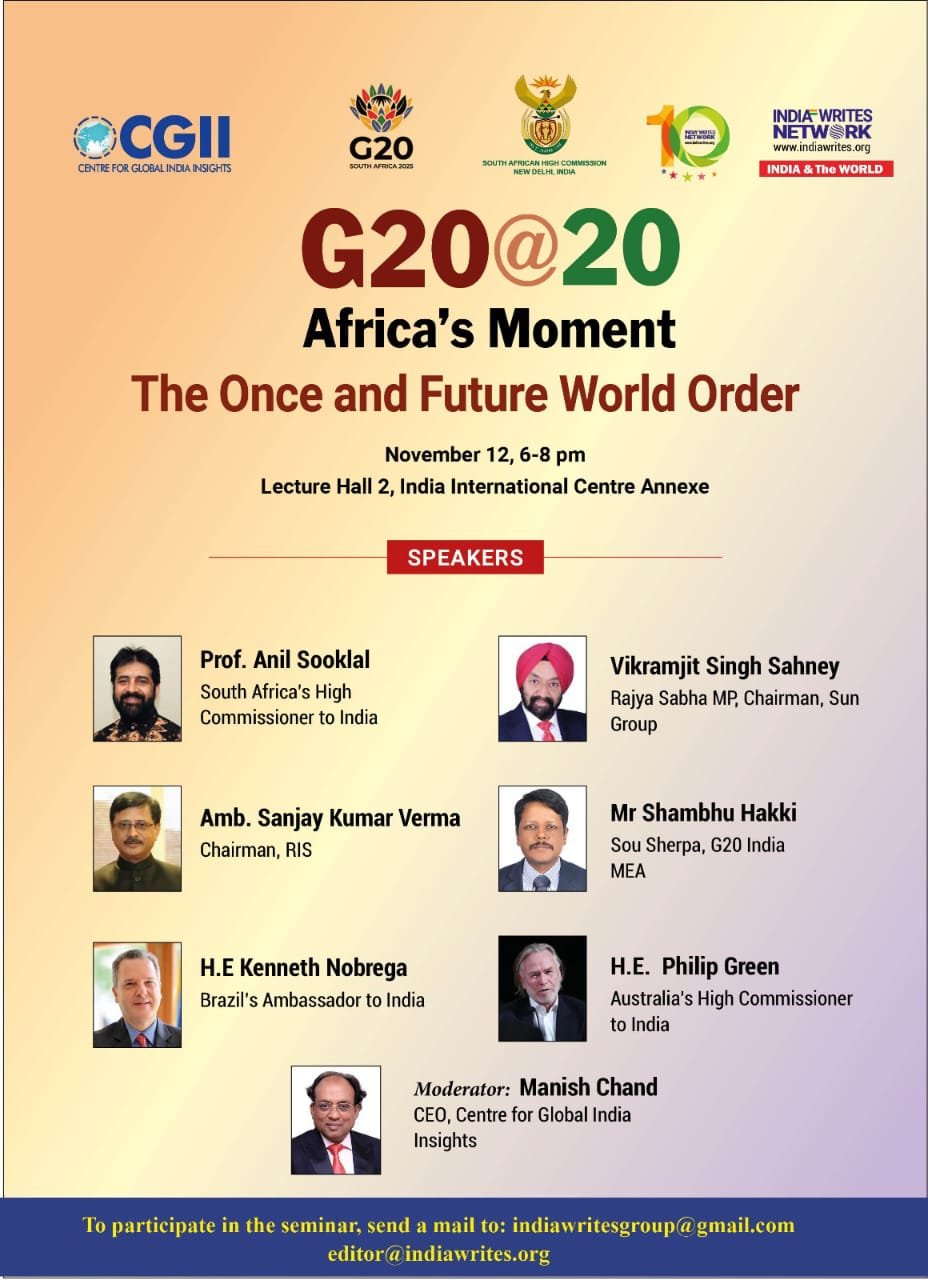
G20@20: Africa’s Moment – The Once and Future World Order
Speakers
Professor Anil Sooklal
Kenneth da Nobrega
Manish Chand
Ambassador Philip Green
sanjay Kumar Verma
Shambhu Hakki
Vikramjit Singh Sahney
MPs, diplomats laud Operation Sindoor, call for national unity to combat Pakistan-sponsored terror
Speakers
Aparajita Sarangi
Brij Lal
Dr Amar Patnaik
Manish Chand
Priyanka Chaturvedi
Sujan Chinoy
Yashvardhan Kumar Sinha
BRICS summit in Rio to focus on Global South, local currency trade
Speakers
Dammu Ravi
Denis Alipov
Ina Hagniningtyas Krisnamurthi
Jyoti Vij
Kamel Zayed Kamel Galal
Kenneth da Nobrega
Manish Chand
Book
India’s G20 Legacy: Shaping a New World Order
Editor: Manish Chand
Pages: 206
Publisher: Pentagon Press LLP
Cover Price: INR 995
In Conversation
India, Israel have to work faster to defeat terrorists: Israel’s Ambassador
In The Press
Rescuing G20 from North-South divide: Ubuntu Moment
The Sunday Guardian: India calls for strengthened BRICS cooperation
Daily Excelsior: Ahead BRICS summit in Rio, envoys call for greater focus on combating terrorism
Rediff: BRICS Summit 2024: Focus on National Currencies
Latest From CGII
Empathy and eros in Tel Aviv bunkers
Modi visit: India-Israel partnership enters a new era
Unravelling Modi’s Israel journey: What to expect
India and Indonesia: Advancing an Inclusive AI Future for the Global South
Macron in Mumbai : Shaping the Next Phase of India–France Ties
South-by-South: Focus on people-centric solutions at India AI summit
The Journal
India’s G20 Journey – Scaling A New Summit
India’s G20 Moment: Hope, Healing and Harmony