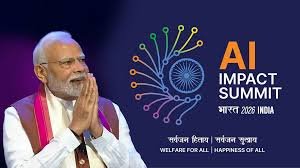
With the overarching goal of forging a global ecosystem of inclusive and people-centric AI, India is hosting the first AI Impact Summit in Global South that will focus on harnessing transformational potential of AI for global public good. The summit, which has brought together leaders, ministers, and top tech CEOs from over 100 countries, aims at amplifying voices from developing nations, with a view to democratizing AI discussions. Geo-strategically, India is looking to leverage the AI summit to forge a “Third Way” beyond the matrix of growing US/China dominance.
For India, a major priority will be to shape how global AI governance conversations are structured to reflect interests and aspirations of the Global South. The previous summits in the UK, South Korea, and France concentrated on frontier model risk, safety thresholds, and voluntary guardrails. The India summit shifts the centre of gravity toward deployment, infrastructure, access, and measurable public impact.
Prime Minister Narendra Modi will deliver the inaugural address on February 19, 2026, and unveil his vision of “AI for All” and “AI for Humanity.” French President Emmanuel Macron, Brazil’s President Luiz Inácio Lula da Silva and David Lammy, UK’s Deputy Prime Minister/Foreign Secretary and the leaders from 20 countries have confirmed their participation. Delegations from over 100 countries are expected to attend.
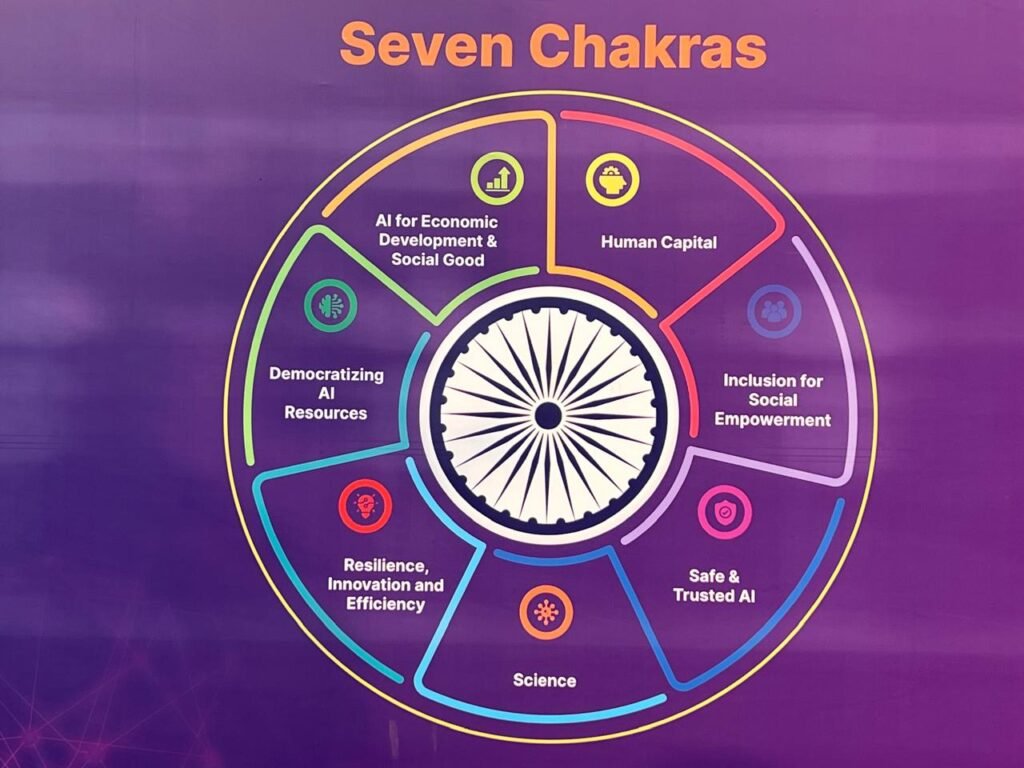
The summit’s agenda is built around three “sutras” — People, Planet, Progress — and seven working tracks covering human capital, inclusion, trusted AI, science, resilience and efficiency, shared AI resources, and economic and social applications. Unlike prior summits that treated safety as the entry point, this structure treats deployment domains and infrastructure access as first-order policy questions.
The summit combines keynote interventions, policy panels, and expert roundtables with the launch of the India AI Expo, which sits inside the main summit architecture rather than at the margins. Startups, research institutions, industry platforms, and public-sector AI systems are showcased as governance-relevant artifacts — not just commercial products.
At the diplomatic level, a Leaders’ Declaration will be adopted on the final day on February 20, 2026. Negotiations on the text of the joint declaration have intensified, with Indian officials aiming to secure more signatories than earlier summits achieved.
Unlike earlier AI summits, the document’s outputs won’t be limited to declarations. Sector casebooks and knowledge compendiums will be unveiled during the summit itself. These documents function as deployment guides and reference frameworks across priority domains such as agriculture advisory, health diagnostics, education platforms, and inclusive service delivery.
Hosting the first such summit in the Global South is framed as agenda diversification — bringing deployment and development priorities into a space previously dominated by frontier safety debates among advanced economies. India will leverage the AI Impact Summit to position itself as a bridge-builder between North and South and advocate for inclusive, equitable AI advancement.
By shifting the global AI discourse from elite-led “safety” or “action” themes (seen in prior summits in the UK and France) to measurable impact, India aims to ensure AI’s benefits reach developing nations disproportionately affected by the current concentration of AI power, resources, and innovation in a few advanced economies.
The summit empowers perspectives from developing countries, countering historical asymmetries in AI governance and infrastructure. It focuses on South-South collaboration, knowledge exchange, and adaptive governance models suited to local contexts (limited connectivity, diverse languages, resource constraints).
Democratizing AI Resources will be one of working groups (one of the “Seven Chakras”) at the summit. It will focus on promoting equitable access to compute, datasets, models, and infrastructure. This includes exploring shared/distributed AI facilities, open innovation, subsidized access (building on India’s own model of low-cost GPUs), and capacity-building to strengthen local ecosystems in developing nations. By hosting the AI summit, the Indian government seeks to make foundational AI tools affordable and accessible, reducing barriers for startups, researchers, MSMEs, and governments in the Global South.
At different sessions of the summit, India will focus on local, multilingual, culturally grounded AI (e.g., models for non-English languages, sector-specific solutions in agriculture, healthcare, education).
According to officials, India will prioritize AI’s role in economic productivity, social development, gender equity, and sustainable sectors. The discussions will focus on “small AI” (efficient, device-based models) for low-resource settings, leapfrogging traditional development pathways in healthcare, agriculture, and public services.
Looking ahead, the overarching goal of India will be to bridge the global AI divide, thereby ensuring benefits accrue broadly rather than concentrating in the Global North. The larger strategic goal for India will be to harness the summit to pitch for a “third way” — a people-centric, public-interest model beyond US corporate dominance or Chinese state control — that prioritizes inclusion, sovereignty, and development impact.











South-by-South: Focus on people-centric solutions at India AI summit
With the overarching goal of forging a global ecosystem of inclusive and people-centric AI, India is hosting the first AI Impact Summit in Global South that will focus on harnessing transformational potential of AI for global public good. The summit, which has brought together leaders, ministers, and top tech CEOs from over 100 countries, aims at amplifying voices from developing nations, with a view to democratizing AI discussions. Geo-strategically, India is looking to leverage the AI summit to forge a “Third Way” beyond the matrix of growing US/China dominance.
For India, a major priority will be to shape how global AI governance conversations are structured to reflect interests and aspirations of the Global South. The previous summits in the UK, South Korea, and France concentrated on frontier model risk, safety thresholds, and voluntary guardrails. The India summit shifts the centre of gravity toward deployment, infrastructure, access, and measurable public impact.
Prime Minister Narendra Modi will deliver the inaugural address on February 19, 2026, and unveil his vision of “AI for All” and “AI for Humanity.” French President Emmanuel Macron, Brazil’s President Luiz Inácio Lula da Silva and David Lammy, UK’s Deputy Prime Minister/Foreign Secretary and the leaders from 20 countries have confirmed their participation. Delegations from over 100 countries are expected to attend.
The summit combines keynote interventions, policy panels, and expert roundtables with the launch of the India AI Expo, which sits inside the main summit architecture rather than at the margins. Startups, research institutions, industry platforms, and public-sector AI systems are showcased as governance-relevant artifacts — not just commercial products.
At the diplomatic level, a Leaders’ Declaration will be adopted on the final day on February 20, 2026. Negotiations on the text of the joint declaration have intensified, with Indian officials aiming to secure more signatories than earlier summits achieved.
Unlike earlier AI summits, the document’s outputs won’t be limited to declarations. Sector casebooks and knowledge compendiums will be unveiled during the summit itself. These documents function as deployment guides and reference frameworks across priority domains such as agriculture advisory, health diagnostics, education platforms, and inclusive service delivery.
Hosting the first such summit in the Global South is framed as agenda diversification — bringing deployment and development priorities into a space previously dominated by frontier safety debates among advanced economies. India will leverage the AI Impact Summit to position itself as a bridge-builder between North and South and advocate for inclusive, equitable AI advancement.
The summit empowers perspectives from developing countries, countering historical asymmetries in AI governance and infrastructure. It focuses on South-South collaboration, knowledge exchange, and adaptive governance models suited to local contexts (limited connectivity, diverse languages, resource constraints).
Democratizing AI Resources will be one of working groups (one of the “Seven Chakras”) at the summit. It will focus on promoting equitable access to compute, datasets, models, and infrastructure. This includes exploring shared/distributed AI facilities, open innovation, subsidized access (building on India’s own model of low-cost GPUs), and capacity-building to strengthen local ecosystems in developing nations. By hosting the AI summit, the Indian government seeks to make foundational AI tools affordable and accessible, reducing barriers for startups, researchers, MSMEs, and governments in the Global South.
At different sessions of the summit, India will focus on local, multilingual, culturally grounded AI (e.g., models for non-English languages, sector-specific solutions in agriculture, healthcare, education).
According to officials, India will prioritize AI’s role in economic productivity, social development, gender equity, and sustainable sectors. The discussions will focus on “small AI” (efficient, device-based models) for low-resource settings, leapfrogging traditional development pathways in healthcare, agriculture, and public services.
Manish Chand
Related Posts
Eyewitness recalls: US-Israel-Iran war, up close and personal
Trump dials Modi: Focus on ending war and keeping Hormuz open
Empathy and eros in Tel Aviv bunkers
India backs diplomacy and dialogue to resolve U.S.-Israel-Iran conflict: Jaishankar
India, Israel have to work faster to defeat terrorists: Israel’s Ambassador
Modi visit: India-Israel partnership enters a new era
Latest Events
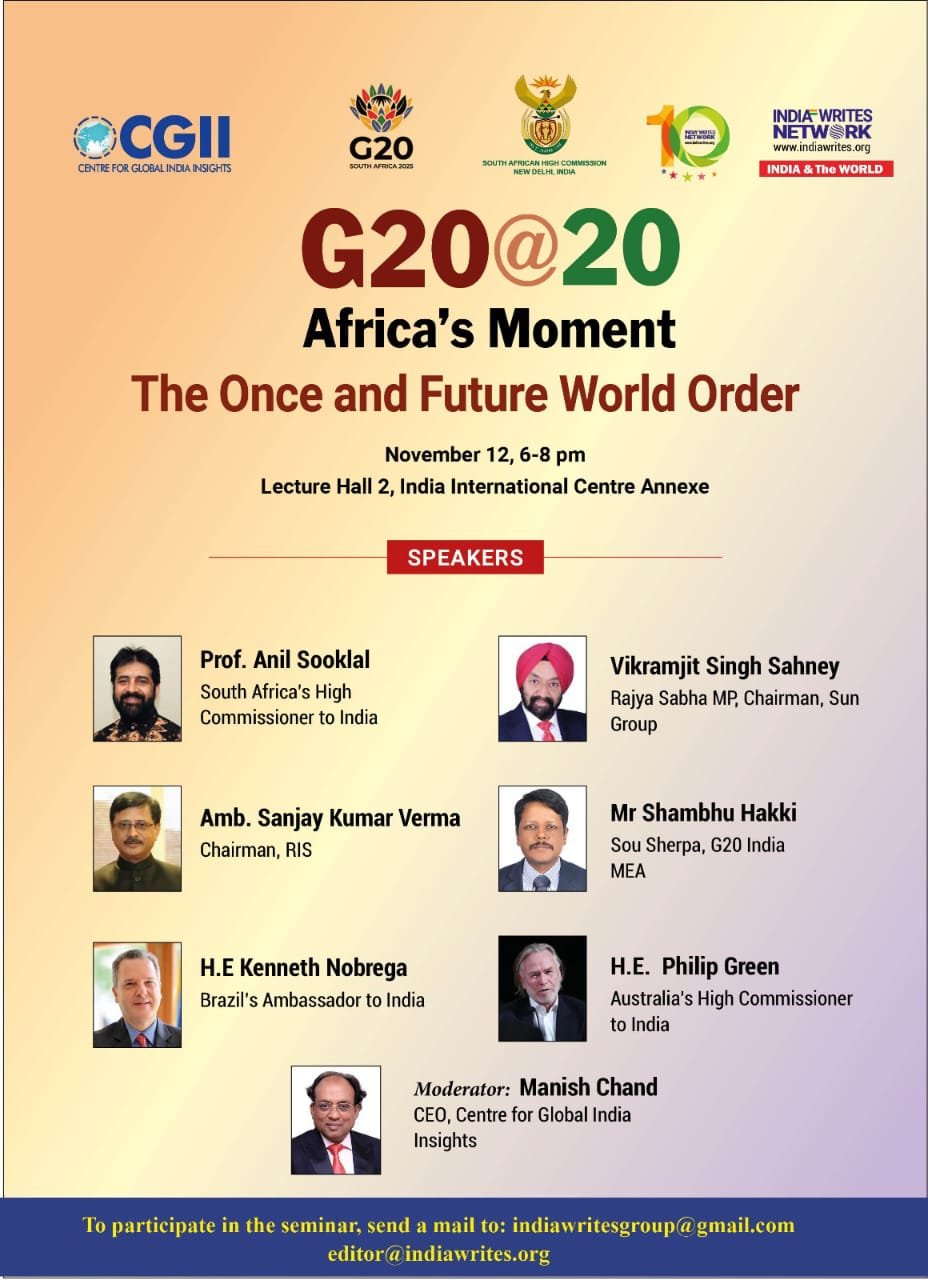
G20@20: Africa’s Moment – The Once and Future World Order
Speakers
Professor Anil Sooklal
Kenneth da Nobrega
Manish Chand
Ambassador Philip Green
sanjay Kumar Verma
Shambhu Hakki
Vikramjit Singh Sahney
MPs, diplomats laud Operation Sindoor, call for national unity to combat Pakistan-sponsored terror
Speakers
Aparajita Sarangi
Brij Lal
Dr Amar Patnaik
Manish Chand
Priyanka Chaturvedi
Sujan Chinoy
Yashvardhan Kumar Sinha
BRICS summit in Rio to focus on Global South, local currency trade
Speakers
Dammu Ravi
Denis Alipov
Ina Hagniningtyas Krisnamurthi
Jyoti Vij
Kamel Zayed Kamel Galal
Kenneth da Nobrega
Manish Chand
Book
India’s G20 Legacy: Shaping a New World Order
Editor: Manish Chand
Pages: 206
Publisher: Pentagon Press LLP
Cover Price: INR 995
In Conversation
India, Israel have to work faster to defeat terrorists: Israel’s Ambassador
In The Press
Rescuing G20 from North-South divide: Ubuntu Moment
The Sunday Guardian: India calls for strengthened BRICS cooperation
Daily Excelsior: Ahead BRICS summit in Rio, envoys call for greater focus on combating terrorism
Rediff: BRICS Summit 2024: Focus on National Currencies
Latest From CGII
Eyewitness recalls: US-Israel-Iran war, up close and personal
Empathy and eros in Tel Aviv bunkers
Modi visit: India-Israel partnership enters a new era
Unravelling Modi’s Israel journey: What to expect
India and Indonesia: Advancing an Inclusive AI Future for the Global South
Macron in Mumbai : Shaping the Next Phase of India–France Ties
The Journal
India’s G20 Journey – Scaling A New Summit
India’s G20 Moment: Hope, Healing and Harmony