


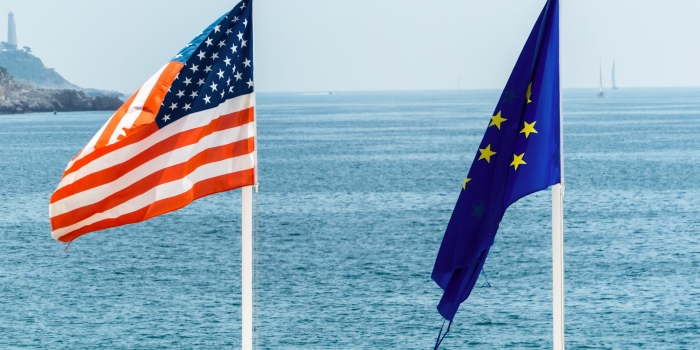
 Losing out for not being a part of the mega trade deal, the Trans-Pacific Partnership (TPP) which was signed between the US, Japan and 10 other Pacific Rim countries, China has expressed its openness to join the Trans-Atlantic mega trade bloc Transatlantic Trade and Investment Partnership (TTIP). “China takes an ‘open attitude’ toward the Transatlantic Trade and Investment Partnership (TTIP), a trade deal being negotiated between the European Union and the United States, so long as it is open and transparent,” Mr. Shen Danyang, a senior Chinese official spokesman of the Ministry of Commerce (MOC) said during a press conference. Mr. Shen said that China had been paying attention to the TTIP negotiations, and it takes an open attitude toward any free trade agreement on global trade liberalisation and regional economic integration. However, he asserted that China will have an open attitude to any major free trade agreement as long as the agreement sticks to the principle of openness and transparency. “China holds that free trade deals in all regions and of all types should be transparent, open and inclusive and be conducive to promoting the well-being of people all over the world. This is also applicable to our attitude toward the TTIP,” Mr. Shen added. The US and EU make up 47 percent of global economy, 28 percent of international trade and 53 percent of foreign investment. The two sides have already conducted 11 rounds of the TTIP negotiations. They have had discussions pertaining to market access, the service sector, investment and IPR. “We noticed that the two sides still have differences in a number of areas such as goods trade, service trade, investment and regulatory compatibility. Therefore, it is just something natural for the sides to speed up negotiations for substantial progress,” Mr. Shen said. TPP and US Rebalance of Asia The US pursued the TPP aggressively to counter the rise of China in the Asia-Pacific and also increasingly having its grip on writing the rules of the global financial system. The rise of China’s development institutions such as Asian Infrastructure Investment Bank (AIIB) and the New Development Bank (NDB) challenging the existing Bretton Woods institutions had led to many analysts and critics writing off the American dominance in the global financial system. However, with the inking of the TPP, which is a mega trade bloc comprising two of the top 3 global economies the US and Japan, the bloc accounts for nearly 40 percent of global GDP. TPP was initially started with the intention of countering the rise of China economically and militarily in the region. The TPP is expected to put the US in a pole position in defining how trade will be conducted in this region and reinforces its leadership in setting rules for global best practices. The TPP was also hailed by many foreign policy analysts and scholars as a success for the Obama administration. This is especially important in the light of recent attempts by China to encroach upon the territory in the South China Sea and the US attempt to assert all countries’ common rights over this territory. With the growing dominance of the TTP partners in the Asia-Pacific region, it will be increasingly difficult for China to illegally encroach upon territories it does not own and it will be possible for the international community to contain China by economic controls rather than direct military conflict.


