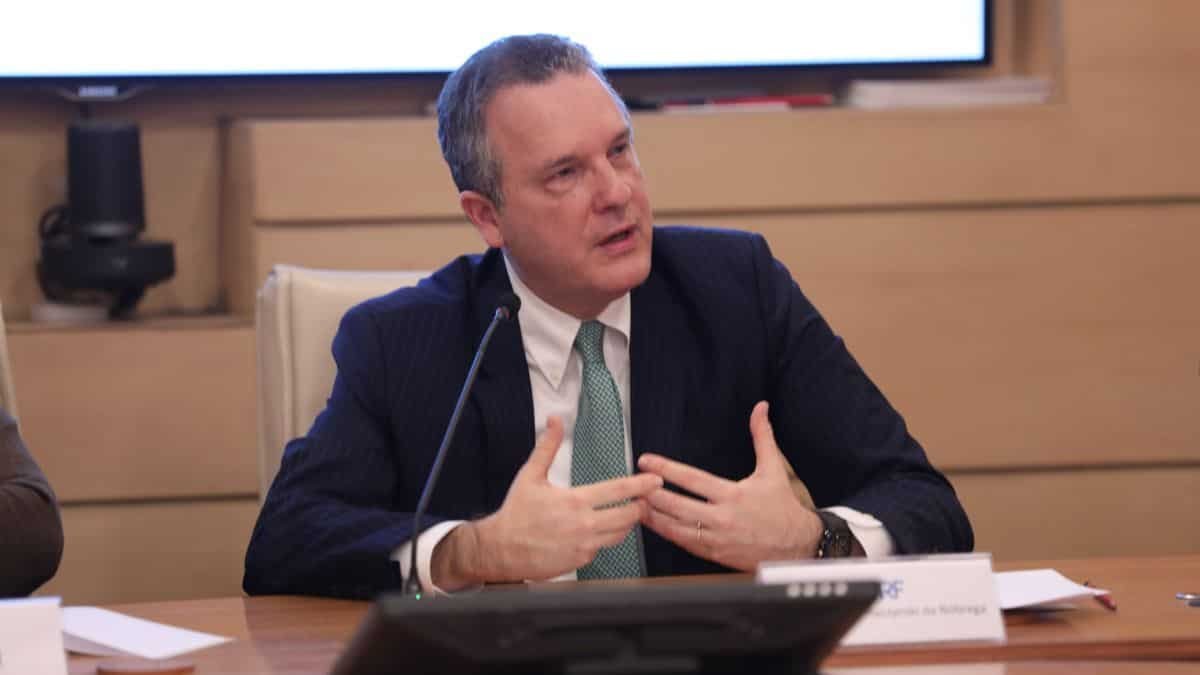


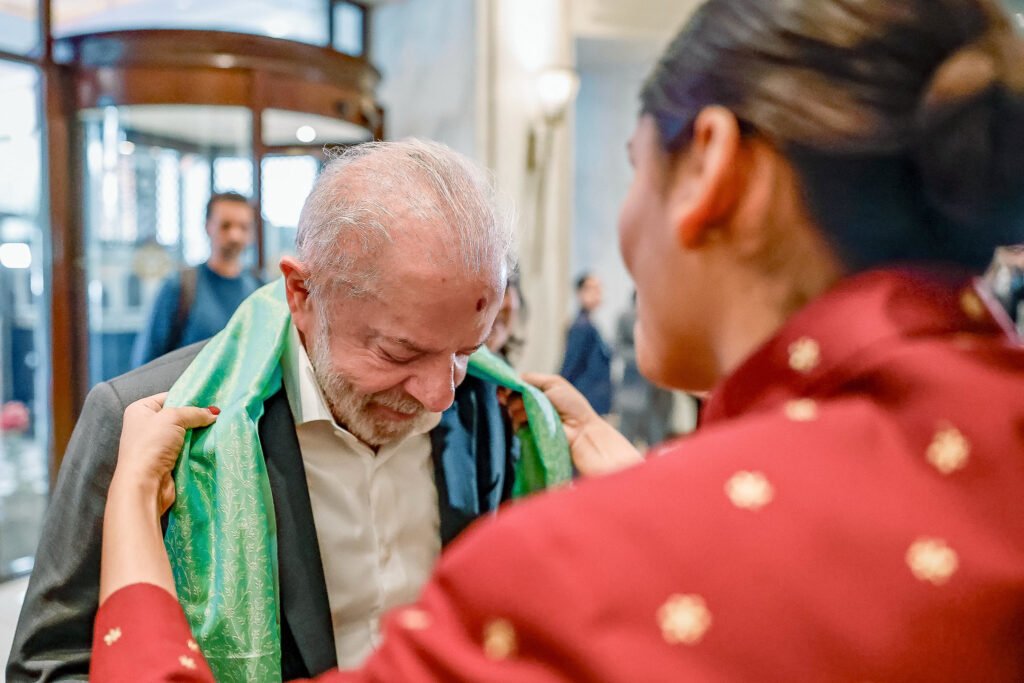
Q) Brazil’s President Lula da Silva has come to India with a large delegation of senior ministers and business titans. This is unprecedented. What has prompted President Lula to visit India with such a large delegation?
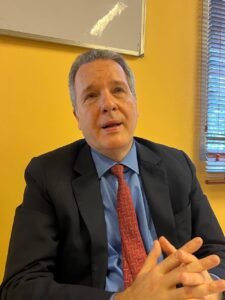
A) There is the geopolitical rationale. In this very admirable new world of geopolitics we are living in, India and Brazil have a very long relationship, grounded in mutual trust. Trust cannot be overemphasized as a factor in solidifying bilateral relations. India and Brazil have so much to gain in intensifying their bilateral relations in the economic and technological fields. The two countries need to coordinate more to help themselves navigate this brave new world of geopolitics.
Then, there is the economic and technological rationale. In the last three years-and-a-half, I received almost 100 business missions from Brazil. More than 20 missions from technological agencies of Brazil, either state agencies or private agencies or private universities, are looking for partnerships in India. We are talking about partnerships between businesspeople, partnerships among people from the research world and people who navigate between the research and innovation world and the business world.
This has provided a rationale for intensifying outreach to India, in the sense that Brazilian society is looking for more from India and vice versa. Lula’s visit, with so many cabinet ministers accompanying and 300 plus businessmen, reflects the reality that the two countries are coming closer in their bilateral relations. There are tremendous opportunities; this explains the huge delegations.
Many Brazilian companies have made new investment in India and are in the process of doing so. Embraco, the Brazilian air conditioning compressors producer, one among the largest in the world, will be inaugurating a production unit in Maharashtra worth USD 120 million investment. Last month, Embraer concluded an agreement of understanding with the Adani Group, which will pave the way for a joint venture in the future regarding the production of commercial airplanes. Tramontina, a Brazilian big cutlery global corporation, is coming to India and establishing a production unit.
We have introduced an electronic visa for India. We have simplified the visa procedures for Indians to travel to Brazil. We are now issuing 10-years visas for Indians. One can expect more business-to-business and people-to-people contacts.
Q) How has the narrative of India changed among Brazil’s business community? What has triggered this change and what kind of investment can we expect in the future?
A) This is because of the stability of India and India’s emergence as a growing powerhouse in South Asia, coupled with this continuous breakneck economic growth. India has been growing at 6-7-8 percent per year for more than 25 years now. So, these two facts have kind of dawned upon the Brazilian business community. Also, India has become the world’s fastest growing major economy, with the level of growth surpassing, overtaking and surpassing China. This perception of a stable, institutionally stable democracy plus a place where there is money to be made — these two factors have enhanced India’s attractiveness for Brazilian companies.
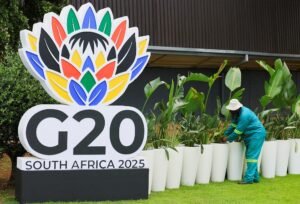
What has contributed to boosting India’s image in Brazil was its G20 presidency two years ago. I came to India as the ambassador late in July 2023. So, I was preparing myself for this assignment and I noticed that throughout 2023, as compared to 2022, the number of Indian articles in Brazilian media on India really increased a lot.
Q) Apart from business deals, what kind of G2G agreements can we expect during President Lula’s visit?
A) There are a number of them that are under negotiations, but the one that is guaranteed is a declaration on our digital partnership. It’s perhaps less well known, but Brazil has developed a partnership in terms of digital public infrastructure, where Brazil has also its digital public infrastructure, but India has a more encompassing one. Brazil is looking to India to provide the technology relating to supercomputers. Brazil is acquiring supercomputers from India under a deal, where we will start assembling them there and then getting technology transfers from India.
There will be a memorandum of understanding on critical minerals and hydrocarbons. There will be a memorandum of understanding between the health agencies– between the Brazilian and Indian health agencies– namely between Anvisa and CDSCO. This will expedite the approval of Indian medicines in the Brazilian market. This is a significant move because if you expedite the process of registering, you really facilitate market access of Indian medicines to Brazil. Brazil stands to gain from that because Brazil, with a universal health care program, needs cheaper sources of reliable medicines. So, Brazil is shifting its procurement from some countries to India.
Brazil is offering some incentives for some Indian companies to start producing active ingredients of medicines in Brazil with the goal that Brazil wants to become self-reliant in a certain number of key medicines.
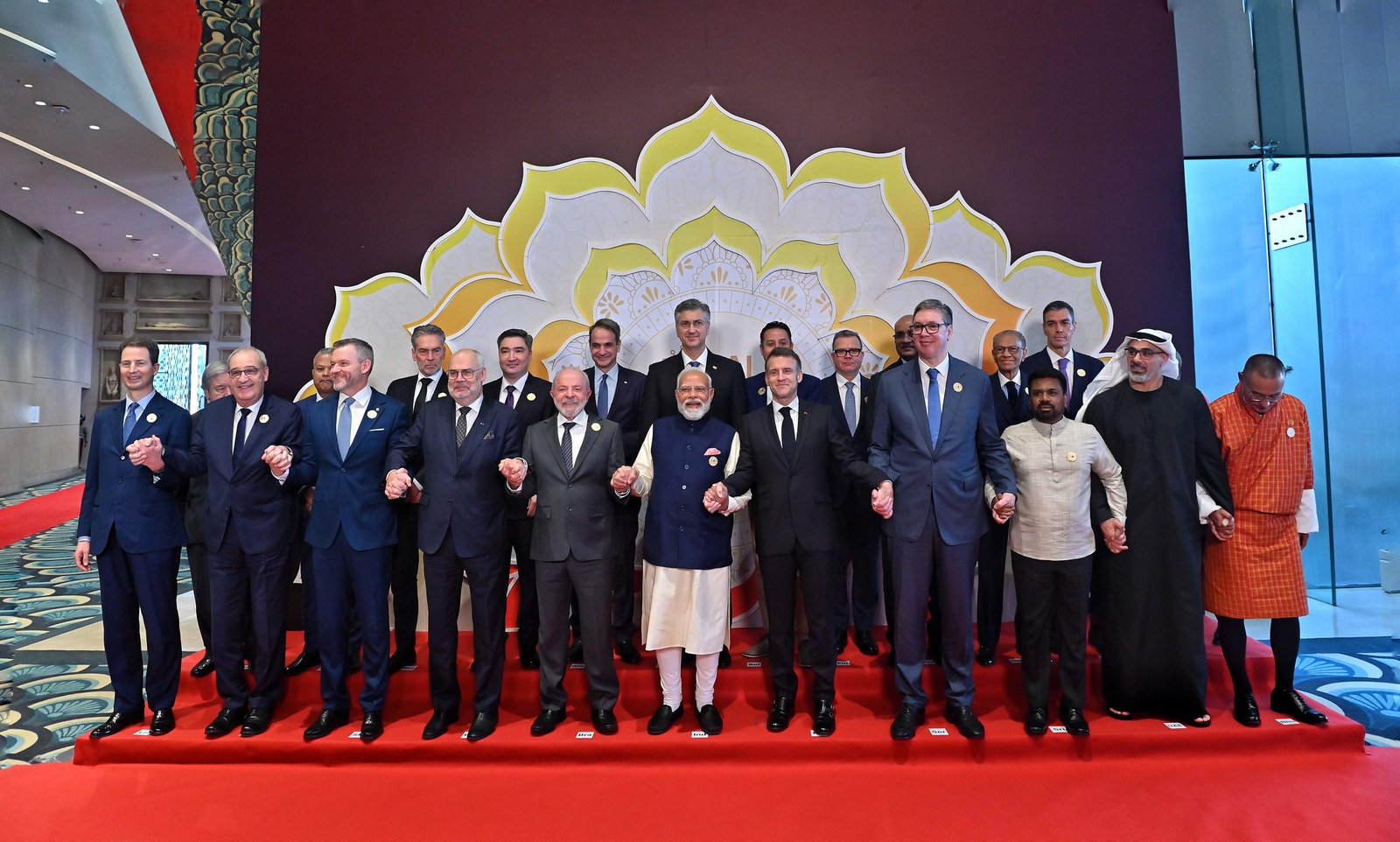
Q) In the area of defence cooperation, what progress can one expect?
A) The idea is to facilitate industrial cooperation between our defense industries. Brazil and India are looking at defense co-production and co-development. We already have a G2G agreement for sharing know-how regarding the maintenance of submarine Scorpene. India and Brazil have bought submarines for defence and the maintenance costs are very high.
India would like to sell Akash missile system to Brazil. This is under discussion.
Brazil is reconfiguring the terms of the bid. Brazil is also looking to acquire patrol vessels from India for marine surveillance. Brazil is also keen to sell KC-390, the medium distance cargo aircraft to India.
Q) What about critical minerals cooperation?
A) Brazil is the third largest country, or perhaps the second, when it comes to reserves of critical minerals plus rare earths. So, the potential is immense. What is concrete within this framework is that India has put in place a critical minerals mission. Brazil is also in the process of putting a similar agency. We want to cooperate in terms of common exploitation of the minerals and processing in Brazil. Brazil also wants to process here.
Q) Both Brazil and India have suffered at the hands of unilateral tariffs. How would you place President Lula’s visit in the geopolitical context? Do you think this visit by President Lula will help Brazil to reduce its dependence on US and China?
A) The two countries are looking for ways to navigate unsure waters. Both India and Brazil are BRICS members. Their relations are not confined to one group – just one group of countries, G7 or United States. We are countries that are very proud of having a very autonomous foreign policy, which really looks at the interests of the country in a very principled way, but also in a pragmatic way. Combining principles and pragmatism is an alchemy of sorts. The leaders of the two countries benefit from comparing notes in enhancing cooperation in multilateral groupings.
Q) Brazil and India are cooperating across multilateral platform– BRICS, IBSA and G20. India will be hosting the BRICS summit later this year. How do you see the alignment between Brazil’s BRICS priorities and India’s BRICS priorities?
A) India and Brazil have always coordinated closely within BRICS. We focus on playing down differences and looking for areas such as health where we can do things together to the benefit of all.
Another important point of cooperation is terrorism. Brazil has always supported India’s emphasis on having outright condemnation of terrorism within BRICS. So, the BRICS joint statements throughout the years included vigorous condemnation of terrorism.
Q) Both India and Brazil are leaders and champions of Global South. How can the two countries enhance coordination in Global South?
A) Many countries of the Global South are looking to India and to Brazil and seeing how we are navigating and how we can help them navigate. The rise of indebtedness in the Global South countries is something tragic. We have a common interest in ensuring food security for the Global South. India is doing great in exporting and sharing its public digital infrastructure with fellow countries of the Global South.
Q) You have known President Lula for a long time. What are his views on India?
A) Well, President Lula came here for the first time in 2005. The big landmark was when the strategic partnership was launched. Brazil-India relations were already very good because we had this traditional coordination in WTO, UN, and WHO. But when Lula came, he came with a vision that this partnership should be one of the key partnerships of our foreign policy. I also wish to stress that Lula has an inborn connection with people. Indian and Brazilians have a lot in common; they are smiling people. They connect with a smile.
This is what Lula always really admired about India. Because he is a people’s man. He loves connecting to people of India.
Q) So, there is going to be a lot more smiling after President Lula’s visit.
A) Yes, more smiles.