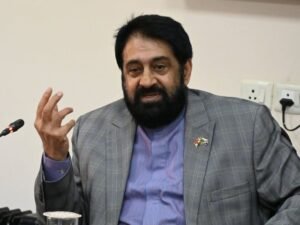

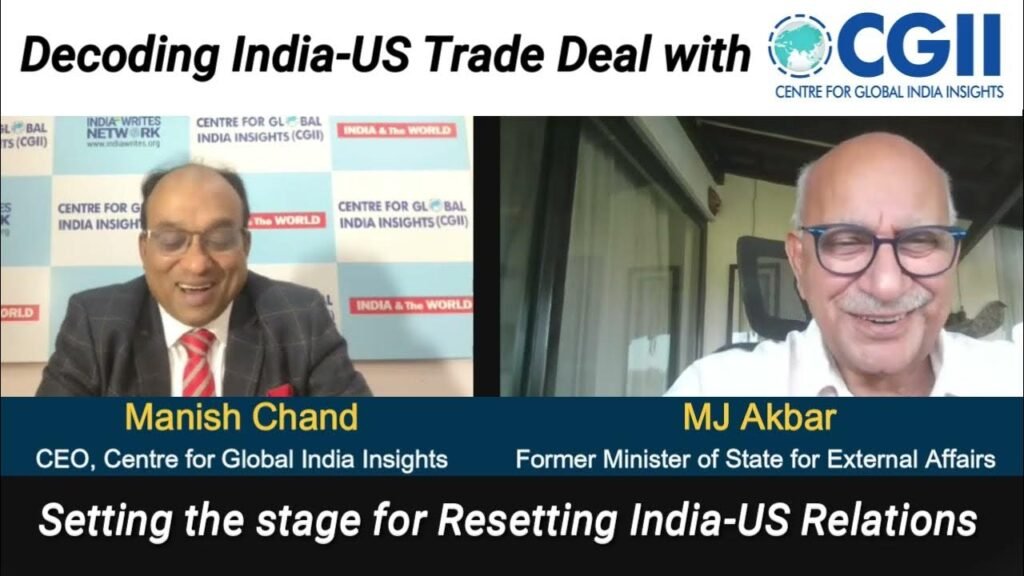
(Edited excerpts from the interview)
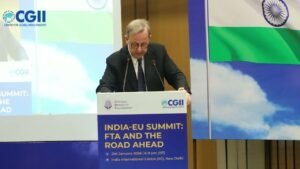
Q) It seems to be the season of trade deals. On January 27, 2026, India and the 27-nation European Union announced he conclusion of the “mother of all deals.” And now, we have the big deal with the United States of America. How do you look at the timing of this announcement and the significance of this moment in India-U.S. relations?
A) Let’s begin with a brief look at your phrase, the “season of trade deals”. This season of trade deals began a few months ago with unpredictable storms, which President Donald Trump unleashed, not only on India, but he unleashed them across the world. In fact, the storms seem more directed at allies and friends of the United States than its declared foes. It was an exercise in the US president using the perceived power of the United States to improve his balance sheet.
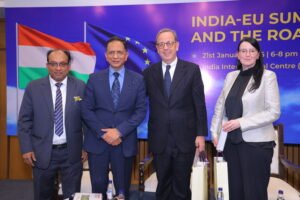
While the rest of the world was going through various degrees of shock, and the shock was most pronounced in Europe, which could not believe that not only was trade being challenged, but the very basis of NATO itself was unraveling, right in front of them with the Ukraine war still going on. At that moment, the only country, the only leader of a country to stand up against an arbitrary decision was Prime Minister Modi. He made it very clear that India was not going to accept any arbitrary decisions. He stood up for India’s dignity, India’s self-respect, India’s strategic autonomy, and India’s readiness. India had discussions on trade with America for long months, but this showed India’s unwillingness to succumb. Prime Minister Modi at that time – it’s not a secret, was heavily criticized by what I would call a rather small but persistent Delhi lobby, who argued that a little verbal compromise would go a long way with Washington. Prime Minister Modi preferred diplomacy and silence while the world watched. India would not relent. In the meantime – because India has been negotiating with Europe also for a long while – the negotiations picked pace and led to the extraordinary announcement of what the European leader described as the “mother of all deals”. This was announced on January 27. And the fact that the European leaders were the chief guests at the Republic Day means that the principles of the deal had been negotiated and agreed upon much earlier, because these invitations have to be given in advance.
The first reactions of Washington to the India-EU deal were very negative. The Trump administration realized what has happened is that the Americans had been finished. India had found a major alternative market for all the goods that used to go to America. And while no market can be a complete replacement of the other, the fact is that once a market is lost, it is very rarely recovered. So, if the Indian goods, say, for example in gems, or in seafood, or in textiles, had found a market in Europe, which they would have done, which they would have done under the new tariff regimes, then the pain would have been American.
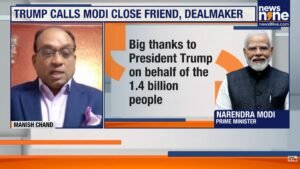
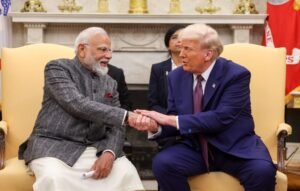
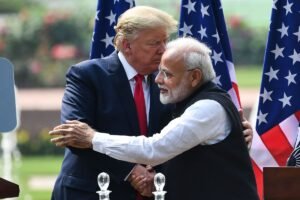
The realization of this prompted at least the two principal leaders, Prime Minister Modi and President Trump, that it was time to conclude the deal.
Q) You rightly said that Prime Minister Modi stood up to Trump’s relentless pressure. And in retrospect, it has paid off. Would you say that the deal is a triumph of India’s approach of strategic autonomy and strategic patience? Do you think this is going to lead to the recasting or resetting of the India-US partnership, which had lost some of its traction in the last few months?
A) Yes, I have described this India-US trade agreement as the first child of the “mother of all deals.” The consequences are quite evident. Certainly, it will bring the India-US relations on an even keel. We are very good friends. It is one of the paradoxes of our modern history, that India and America, both democracies, both countries which love freedom, both perhaps share knowledge of the English language and communication systems and media, still are distanced by a political gulf. But that political gulf has other reasons. That is because of an accident of history, in which America at a particular moment in 1948– between 1948 and 1952– America decided that it would prefer a military alliance and bases in Pakistan against the Soviet threat. At that time, it preferred a non-military relationship with India.
Be that as it may, at this moment, what we are looking at is restoration. The India-US trade deal has implications for the whole world. It is not simply a bilateral matter, because the whole world has suddenly discovered that if you have patience, if you have a good argument on your side, then eventually the diplomatic route and the ability to stand up will pay dividends. You can see a softening of the American position now, suddenly, across Latin America, as if the American diplomatic aggression has exhausted itself.
Q) You rightly said this deal has implications that go beyond India and the United States. What kind of signal does the deal send to China? Has Donald Trump has again revived the idea of G2?
A) The manner in which China has handled the present turbulence with America is also something that we should respect. They too, they too never succumbed. They didn’t get buffeted by the storms. They kept quiet. They did their negotiations. In fact, President Trump startled everyone who had been listening to him so far, since he had made China his principal threat, by his announcement that he was going to visit China in April. So, China has been able to handle its equation with Russia and its equation with America, in a very mature fashion.
India has shown that a core principle of what should be called the Modi doctrine is cooperative nationalism. Nationalism is absolutely central to his whole philosophy of governance. India first, India’s interest first. But not attached to hostility. Always ready to offer cooperation, so that an agreement can be worked out on the basis of mutual benefit. Mutual benefit is a phrase that has been used by the Indian side in its readout of the Indo-US treaty. Indeed, that is the principle on which Prime Minister Modi operates. India first, and India ready to cooperate.
Q) The deal has come amid shifting geopolitical equations and competitive power play. What did it say about India’s rising global stature?
A) Prime Minister Modi very clearly has shown that India is capable of being one of the major leaders of world affairs. The ability with which he has handled this relationship with America has become, –whether they admit it or not– a template, a guide for others, that are seeking negotiations and amicable relationship with the world’s primary superpower.
There’s no doubt about American power. There’s no doubt about American influence. There’s no doubt about America’s ability to be a force for the good, as much as a force which can be dangerous when hostile. But I think there is a difference between showing respect for American capability and accepting any power or superpower as the king of the world. That age of empires is over.
Before 75 years, we in India have led the world in our understanding of what independence means. Prime Minister Modi has certainly strengthened India’s position in the world, and this is going to be reflected in the manner in which the world now accepts India. The relationship between India and the EU is only the beginning of a new era in India’s global standing.