



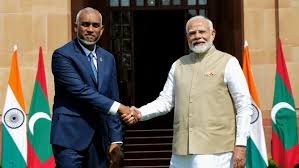
 New Delhi: In a significant boost to bilateral ties, India and the Maldives signed several key Memorandums of Understanding (MOUs), marking a new phase of cooperation between the two neighbors. The agreements were exchanged during a virtual ceremony between the President of Maldives, Dr. Mohamed Muizzu, and Indian Prime Minister Narendra Modi, solidifying collaborations in areas ranging from infrastructure and social housing to anti-corruption and law enforcement. The MOUs reflect a broad spectrum of cooperation, addressing multiple critical sectors. One of the standout initiatives was the introduction of India’s Ru Pay card system in the Maldives aimed at simplifying transactions for Indian tourists and boosting the island nation’s tourism sector. Another milestone was the virtual inauguration of the new runway at Hanimaadhoo International Airport, part of a $132 million redevelopment project financed through an Indian line of credit. In addition, India handed over 700 housing units, part of a larger project involving 4,000 units to provide affordable living spaces for Maldivians. Other agreements focused on institutional cooperation, including capacity building for law enforcement and judiciary, alongside a partnership to combat corruption. These initiatives underscore India’s role as a key development partner for the Maldives. President Muizzu’s visit to India is a turning point in the evolving relationship between the two countries. Relations were strained following President Muizzu’s rise to power in 2023, driven by his “India Out” campaign, which called for the removal of Indian military personnel stationed in the Maldives. The campaign caused diplomatic friction, with both nations navigating a delicate period. However, in recent months, both New Delhi and Malé have taken steps to repair ties, culminating in the MOUs signed today. The visit marks President Muizzu’s first official bilateral engagement with India since assuming office, signaling his intent to recalibrate relations with the regional powerhouse. During his visit, President Muizzu and Prime Minister Modi engaged in discussions focused on regional security, development cooperation, and economic ties. This thaw in relations was foreshadowed by earlier diplomatic gestures, including a visit to the Maldives by India’s External Affairs Minister, Dr. S. Jaishankar, in August 2024, and India’s assistance in helping the Maldives avoid a default on its Islamic bond payments by extending treasury bill support. Prime Minister Modi, while addressing the media, emphasized the historical ties between the two nations, stating, “India and the Maldives share a bond rooted in centuries of trade and cultural exchange. Today’s agreements reaffirm our commitment to fostering peace, stability, and development in the region.” President Muizzu echoed these sentiments, expressing gratitude for India’s continued support, particularly in the areas of infrastructure development and economic resilience. The timing of President Muizzu’s visit is significant. The Maldives, grappling with economic challenges and a drop in foreign reserves, is keen to bolster its ties with India, a critical development partner. Despite earlier tensions over the presence of Indian military personnel, President Muizzu has toned down the anti-India rhetoric, acknowledging India’s vital role in the Maldives’ economic and infrastructural development. He remarked, “India is a valued partner, and we are committed to ensuring our bilateral ties remain strong and productive.” New Delhi, for its part, is also cautious of the Maldives” strategic position in the Indian Ocean, a region where China’s growing influence has raised concerns. By solidifying its ties with the Maldives, India is not only safeguarding its strategic interests but also reinforcing its leadership role in the Indian Ocean Region. President Muizzu’s assurances that the Maldives would never do anything to undermine India’s security have been well-received in New Delhi, which continues to view Malé as a key ally in maintaining regional stability.