

(Edited Excerpts from the interview)
Q) India’s relationship with the United States of America is currently going through a period of drift. It appears that this so-called defining partnership of the 21st century seems to be in a free fall of sorts. How serious is the crisis in India-US relations?
A: I don’t think we should underestimate the extent of the challenge which are facing vis-à-vis India-US relations. The last 25 years were marked by expanding relations and the two countries finding more areas where they could work together. There was a certain kind of a convergence between India and the US about the regional situation and the global situation. That was very important.
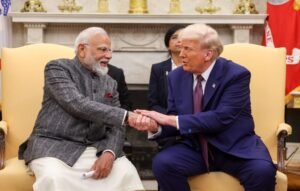
Now, what has happened is that Trump, in a sense, is completely overturning the entire edifice of the relationship. It’s not India alone. Even allies of the United States are facing considerable amount of challenge, to the extent that the German Chancellor, the head of a NATO ally, is saying today the United States of America is the adversary. That is a very shocking statement!
But we should not necessarily make this only an India-US issue. It is an India-US issue, but at the same time it is part and parcel of a much larger global issue. It’s not only India that he is upsetting. He is upsetting other countries also.But of course, the impact on India can be more significant.
Regarding the trade war, it’s important to stress that some important segments of the Indian export economy are very much dependent upon access to the US market.
There is also the issue of whether this is going to be limited so far only to the trade and economic side or is it going to start impacting on other aspects of the relationship. Now, don’t forget that over the last 25 years, for example, the defence relationship between the two countries has become much stronger. Not only in terms of India purchasing US hardware but the two countries working together for co-production. We are looking at technological partnerships in some very high-tech areas. We have very strong counter-terrorism cooperation between our agencies. There is very good intelligence cooperation.
These areas have not yet been impacted. They seem to be continuing as before. But they could be. We can’t exclude that possibility. So, right now the challenge for us is to how keep our heads down.
With this trade war, we have been remarkably restrained in our reactions, thereby keeping the door open for the two sides to reach an understanding.
Q) Geopolitically, we seem to be losing out. There is a growing perception that India is getting re-hyphenated with Pakistan. What’s behind Donald Trump’s sudden love for Pakistan? Days after “Operation Sindoor,” Donald Trump hosted Pakistan’s Army Chief Field Marshal Asim Munir. Is the US pivoting towards Pakistan? What are its consequences for India?
SS: As far as Pakistan Army Chief being hosted at the White House is concerned, Trump has a large ego. He seems to be very much focused on getting a Nobel Prize. Compared to India, which was not ready to give credit to President Trump for the ceasefire that was achieved, Pakistan has not only given Trump fulsome praise but has also nominated him for the Nobel Prize. These factors are perhaps more at play rather than a major strategic shift on part of the United States. It remains to be seen whether this goes further than what we have seen so far.
So, if Pakistan’s effort has been to rehyphenate with India, if the effort of Pakistan is to get international attention focused once again on Jammu and Kashmir, if the intention is to make India-Pakistan relations an international issue, so that there has to be international intervention in order to prevent the two nuclear weapon states from going into an escalatory conflict, this may tempt Pakistan to think this is the time to further provoke India.
Because that way by provoking India, you invite external intervention which they have not been able to do for the last so many years. So, that is something that we need to be, aware of that there is this risk, how Pakistan will interpret Trump’s gesture and what it may do to make some hay out of this.
Q) Trump is famously an egotist. Trump has been trumpeting that he was the one who brokered the ceasefire between India and Pakistan, but we never gave him any credit for it. On the other hand, Pakistan’s leaders praised him and nominated him for the Nobel prize? What prevents us from pandering to his ego a bit and acknowledge in some tangential manner that he is a force for peace. What can India do to please Trump?
A) Well, you have seen a lot of leaders across the world including European leaders who are after all leaders of substantial countries doing precisely that.
What have they achieved? Has that behaviour on their part and giving him a lot of praise and saying you are the best leader – what did it achieve?
Look at the European Union: They sign a trade deal in which they have to pay 15% tariff, but they have to accept US goods at zero tariff. In normal circumstances would any country accept such an unequal deal?
Secondly, even after the deal has been reached, you have Trump saying you are working against our digital companies – Google, Meta and others. And that you should not have the kind of regulations that you have with respect to the digital economy. And that is becoming a sticking point.
So, even when you have pandered to his ego, have you achieved something? That doesn’t seem to be the final word. So, that is something that we have to keep in mind.
Secondly, this is like behaving like a bully. And my view is that if you succumb to a bully in the first instance, don’t be surprised if there are many other demands which will follow.
So, if drawing the line brings you some pain, I think that pain will be much less than what you may end up with by having to keep trying to give in to his demands. I don’t think that India should put itself in that place