




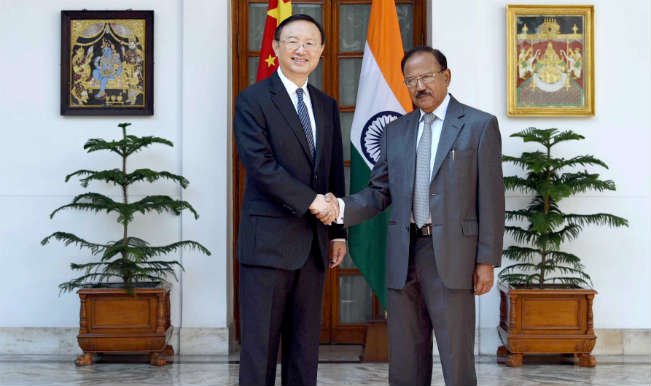
BEIJING: Taking a mature view of their evolving relations, India and China have decided not to let recent differences come in the way of finding “peaceful negotiations” to settle the border dispute and reach a mutually acceptable solution. India’s National Security Advisor Ajit Doval held the 19th round of boundary talks with China’s Special Representative Yang Jiechi in Beijing to discuss the road ahead to resolve the dispute. The two countries had an “extensive, deep and candid” discussion on boundary issues, a brief statement from the Chinese foreign ministry said. The 3,488 km-long Line of Actual Control (LAC) remains undemarcated, a source of off and on tensions between the two Asian giants. “Both sides agreed to adhere to peaceful negotiations to settle the boundary question. They will make efforts to reach a fair, reasonable and mutually acceptable solution,” the statement said. The 18th round of boundary talks was held in India in March 2015. “But we do hope that what we couldn’t do in 2015, we will try and make up for that in 2016. There has been improvement in bilateral exchanges between the two countries in various fields,” Mr Doval said. “China-India relations carry special significance. The Chinese side stands ready to use this important occasion to have broad ranging, in-depth and candid discussions with the Indian side on bilateral relations, the boundary question and regional and international issues and other issues of shared interests,” Mr Yang said after the meeting. The boundary talks took place amid New Delhi’s concerns over Beijing’s blocking of India’s bid in the UN to ban Pakistan-based Jaish-e-Mohammed (JeM) chief Masood Azhar. “Bilateral ties have entered a new era of comprehensive and rapid development since Chinese President Xi Jinping paid a successful visit to India in 2014 and Prime Minister Narendra Modi travelled to China in 2015,” said Chinese state-run Xinhua news agency. Both sides should implement the important consensus between the leaders, enhance high-level interactions, tap the potential of cooperation, and promote China-India relations to a higher level, it said.