


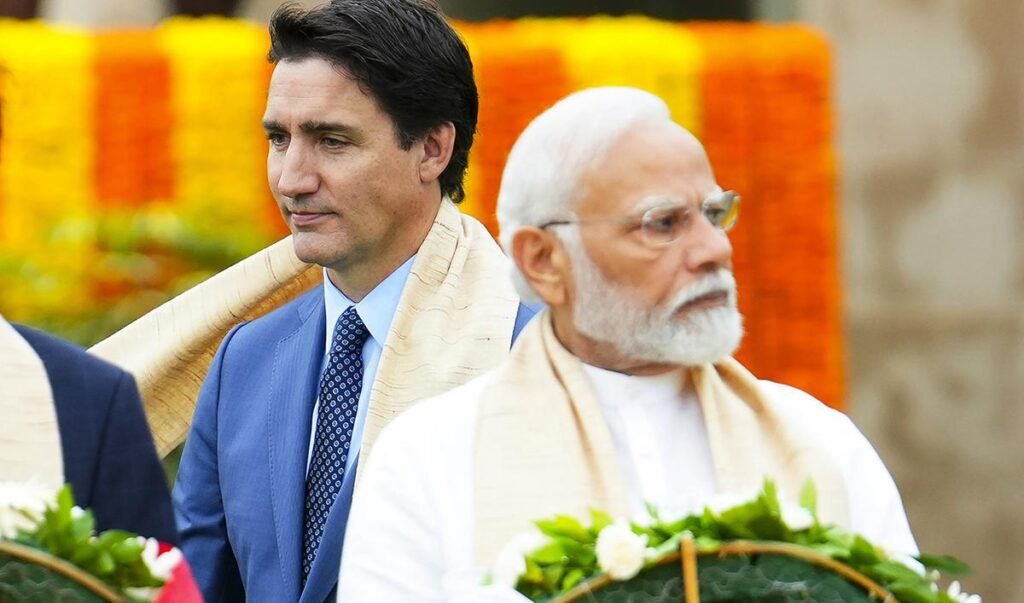
New Delhi: In a sharp rebuke, India hit out at Canadian Prime Minister Justin Trudeau following his deposition at the Foreign Interference Commission. Responding to media queries, India’s Ministry of External Affairs (MEA) spokesperson, Shri Randhir Jaiswal, emphasized that Canada has failed to present any credible evidence linking Indian officials to the 2023 killing of Khalistani separatist Hardeep Singh Nijjar, a key point of contention that has strained relations between the two nations. “What we have heard today only confirms what we have been saying consistently all along – Canada has presented us no evidence whatsoever in support of the serious allegations it has chosen to level against India and Indian diplomats. The responsibility for the damage that this cavalier behaviour has caused to India-Canada relations lies with Prime Minister Trudeau alone,” Jaiswal stated at a press briefing. Trudeau, who testified before the commission on Wednesday, conceded that his government had no “evidentiary proof” but only “intelligence” regarding India’s involvement in Nijjar’s death. This admission further fueled diplomatic tensions between the two nations, with India maintaining its long-held stance that Trudeau's allegations were politically motivated and unsubstantiated. India’s Concerns Over ‘One India’ Commitment Jaiswal also addressed Trudeau’s claim of supporting India’s territorial integrity, specifically referencing his remarks about adhering to a ‘One India’ policy during his testimony. “We have seen Prime Minister Trudeau’s comments about his belief in the ‘One India’ policy, but his actions tell a different story. Anti-India elements that advocate for separatism and disunity, threatening the very ‘One India’ concept, continue to operate freely in Canada with no action taken against them.” The MEA spokesperson pointed out the contradiction between Trudeau words and his government inaction against those advocating for the dismemberment of India, hinting at the lack of follow-through in curbing the activities of pro-Khalistani groups in Canada. The Diplomatic Fallout The row between India and Canada, which began over allegations of India’s involvement in Nijjar’s killing, has escalated in recent days. Earlier this week, the Canadian government requested India to waive diplomatic immunity for its high commissioner and other Indian diplomats, citing them as “persons of interest” in the investigation. In response, India withdrew its high commissioner Sanjay Kumar Verma and five other diplomats before Canada could officially expel them. Jaiswal reaffirmed that the decision to withdraw the diplomats was taken because of concerns over their safety. “We had informed the acting high commissioner that we had no faith the Canadian government would ensure the safety of our diplomats. Subsequently, we received communication from Canada asking them to leave, but our decision was made independently.” India’s Pending Extradition Requests Highlighting India’s broader frustrations, Jaiswal revealed that New Delhi had submitted 26 extradition requests over the past decade and a half for criminals residing in Canada, many of whom are accused of terrorism-related activities. “Despite multiple requests, no action has been taken,” he remarked, listing individuals such as Gurjit Singh and Arshdeep Singh Gill, members of the Lawrence Bishnoi gang, as examples of those sought by Indian authorities. Trudeau’s Concessions on Intelligence During his deposition, Trudeau admitted that Ottawa had only intelligence from its own agencies and Five Eyes allies, rather than concrete evidence, linking Indian diplomats to Nijjar’s assassination. He further claimed that Canadian authorities attempted to engage New Delhi to address concerns but were met with a lack of cooperation. India has repeatedly denied these allegations, dismissing them as an attempt by Trudeau’s government to distract from domestic political issues. “This is not about evidence or justice,” Jaiswal asserted. “This is about political posturing in Canada, at the expense of India-Canada relations.” As the diplomatic row continues, the future of relations between the two countries remains uncertain, with both sides contemplating further retaliatory measures.