India has registered a strong protest against China creation of the two new counties in Hotan Prefecture, one of which encompasses large parts of India’s Union Territory of Ladakh, currently under illegal Chinese occupation in Aksai Chin. India’s Ministry of External Affairs (MEA) sharply criticized Beijing’s unilateral move, asserting it was a blatant attempt to alter the status quo in the disputed area. “We have seen the announcement pertaining to the establishment of two new counties in Hotan Prefecture of China. Parts of the jurisdiction of these so-called counties fall in India’s Union Territory of Ladakh. We have never accepted the illegal Chinese occupation of Indian territory in this area,” said Randhir Jaiswal, spokesperson of India’s external affairs ministry, said during a press briefing on January 3.
“The creation of new counties will neither have a bearing on India’s long-standing and consistent position regarding our sovereignty over the area nor lend legitimacy to China’s illegal and forcible occupation of the same,” said the spokesperson. He also confirmed that a formal protest had been lodged with Beijing through diplomatic channels.
China’s announcement came just days after a renewed attempt at boundary negotiations between the two nations, led by India’s National Security Advisor Ajit Doval and Chinese Foreign Minister Wang Yi. The talks in Beijing on December 18 marked the first round of discussions between Special Representatives in five years following the military standoff in eastern Ladakh in 2020. The timing of Beijing’s controversial decision to alter the status quo, New Delhi contended, undermines the spirit of these negotiations.
The latest move by China involves the creation of He’an and Hekang counties, both administered by Hotan Prefecture in the Xinjiang Uygur Autonomous Region. He’an County incorporates substantial areas within the 38,000 square kilometres of Indian territory that China has occupied since the 1962 war. The state-backed Xinhua news agency reported that the establishment of the new counties had been approved by the Communist Party of China’s Central Committee and the State Council, with Hongliu and Xeyidula townships designated as their administrative headquarters.
China claims nearly 90,000 square kilometres of Indian territory in Arunachal Pradesh, which it refers to as Zangnan or “South Tibet.” Additionally, Beijing lays claim to parts of Himachal Pradesh and Uttarakhand. Conversely, New Delhi maintains that Aksai Chin, along with areas ceded by Pakistan to China in the 1963 Sino-Pakistan Boundary Agreement, is an integral part of India. Over the past few years, China has intensified its strategy to assert claims over disputed regions, employing tactics such as renaming places, enacting a new land boundary law, publishing revised maps, and constructing settlements along contentious borders. Analysts view the establishment of the two counties as another deliberate attempt to solidify its control over contested areas, potentially complicating future boundary negotiations. The ministry highlighted that such actions violate the understanding reached under the 2005 Political Parameters and Guiding Principles for Settlement of the Boundary Question. Articles V and VII of the agreement, which emphasize respecting historical evidence and the sensitivities of settled populations, have been repeatedly disregarded by Beijing, Indian officials contend. The timing of this escalation has sparked concerns among experts, particularly as it comes on the heels of a recent de-escalation in military tensions. In October, India and China reached a significant agreement on patrolling arrangements in the Depsang and Demchok regions along the Line of Actual Control, concluding the withdrawal of frontline troops deployed since 2020. The resumption of talks in December was viewed as a potential thaw in relations, but China’s latest move threatens to derail the fragile progress. India’s strong response reflects serious concern about Beijing’s long-term ambitions in the region. As the boundary dispute continues to fester, New Delhi remains steadfast in asserting its sovereignty. “We have lodged a solemn protest with the Chinese side through diplomatic channels,” the MEA reaffirmed, signalling that unilateral actions will not deter India from defending its territorial integrity.








India protests China’s creation of new counties in disputed territory
India has registered a strong protest against China creation of the two new counties in Hotan Prefecture, one of which encompasses large parts of India’s Union Territory of Ladakh, currently under illegal Chinese occupation in Aksai Chin. India’s Ministry of External Affairs (MEA) sharply criticized Beijing’s unilateral move, asserting it was a blatant attempt to alter the status quo in the disputed area. “We have seen the announcement pertaining to the establishment of two new counties in Hotan Prefecture of China. Parts of the jurisdiction of these so-called counties fall in India’s Union Territory of Ladakh. We have never accepted the illegal Chinese occupation of Indian territory in this area,” said Randhir Jaiswal, spokesperson of India’s external affairs ministry, said during a press briefing on January 3.
China’s announcement came just days after a renewed attempt at boundary negotiations between the two nations, led by India’s National Security Advisor Ajit Doval and Chinese Foreign Minister Wang Yi. The talks in Beijing on December 18 marked the first round of discussions between Special Representatives in five years following the military standoff in eastern Ladakh in 2020. The timing of Beijing’s controversial decision to alter the status quo, New Delhi contended, undermines the spirit of these negotiations.
China claims nearly 90,000 square kilometres of Indian territory in Arunachal Pradesh, which it refers to as Zangnan or “South Tibet.” Additionally, Beijing lays claim to parts of Himachal Pradesh and Uttarakhand. Conversely, New Delhi maintains that Aksai Chin, along with areas ceded by Pakistan to China in the 1963 Sino-Pakistan Boundary Agreement, is an integral part of India. Over the past few years, China has intensified its strategy to assert claims over disputed regions, employing tactics such as renaming places, enacting a new land boundary law, publishing revised maps, and constructing settlements along contentious borders. Analysts view the establishment of the two counties as another deliberate attempt to solidify its control over contested areas, potentially complicating future boundary negotiations. The ministry highlighted that such actions violate the understanding reached under the 2005 Political Parameters and Guiding Principles for Settlement of the Boundary Question. Articles V and VII of the agreement, which emphasize respecting historical evidence and the sensitivities of settled populations, have been repeatedly disregarded by Beijing, Indian officials contend. The timing of this escalation has sparked concerns among experts, particularly as it comes on the heels of a recent de-escalation in military tensions. In October, India and China reached a significant agreement on patrolling arrangements in the Depsang and Demchok regions along the Line of Actual Control, concluding the withdrawal of frontline troops deployed since 2020. The resumption of talks in December was viewed as a potential thaw in relations, but China’s latest move threatens to derail the fragile progress. India’s strong response reflects serious concern about Beijing’s long-term ambitions in the region. As the boundary dispute continues to fester, New Delhi remains steadfast in asserting its sovereignty. “We have lodged a solemn protest with the Chinese side through diplomatic channels,” the MEA reaffirmed, signalling that unilateral actions will not deter India from defending its territorial integrity.
CGII Network
Related Posts
Diplomatic win for India: BRICS bridges Gulf divide, bats for Global South
Illuminating India’s BRICS moment
With Trump listening in, Iran urges PM Modi to end war with US
India Russia ‘dosti’ in Bishkek: Focus on end of Ukraine war, balanced trade
Uncovering Pakistan: Modi rallies SCO against states that use terror as policy
Modi’s SCO agenda: Shaping a region free of terror, widening arc of prosperity
Latest Events
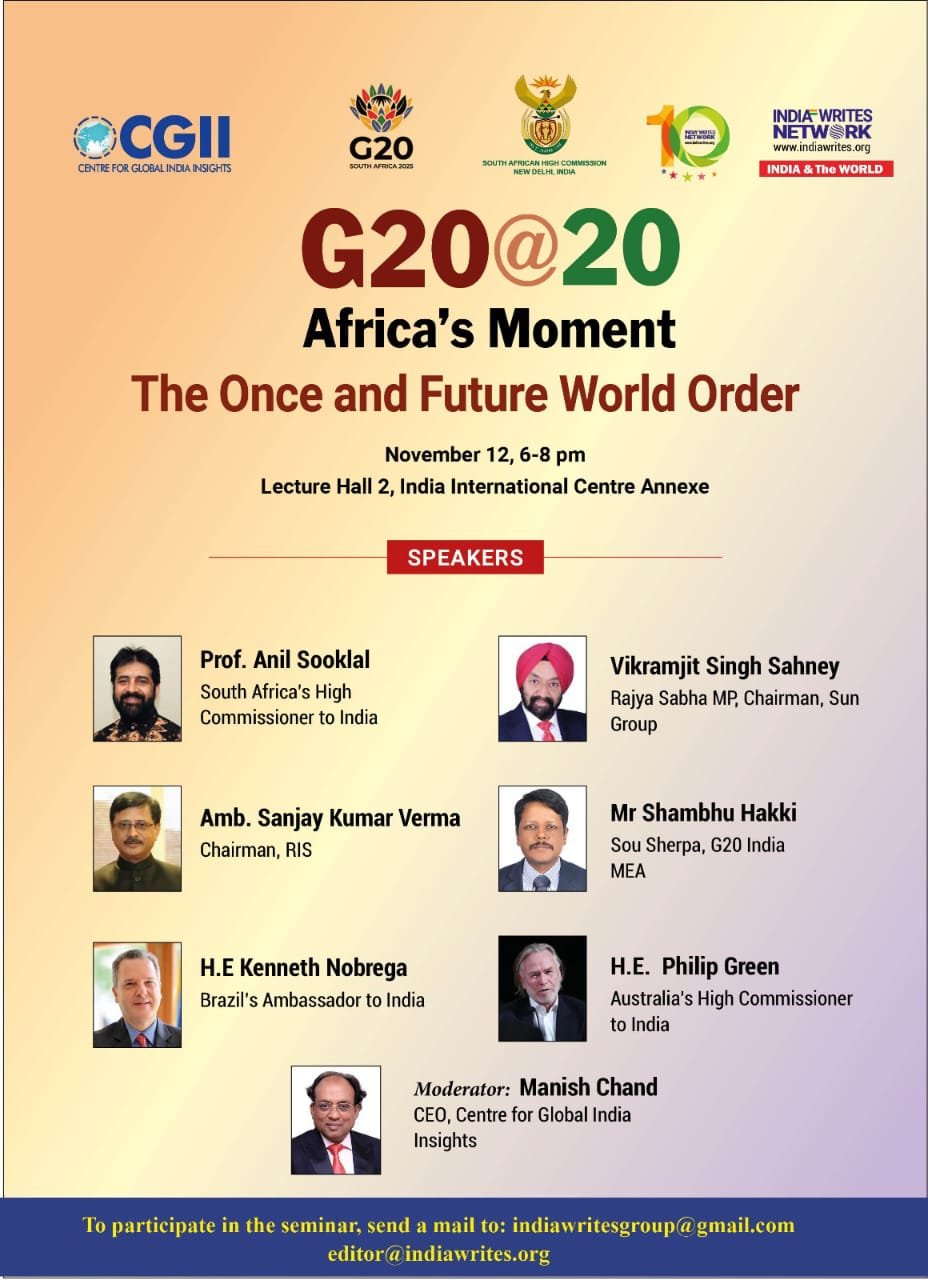
G20@20: Africa’s Moment – The Once and Future World Order
Speakers
Professor Anil Sooklal
Kenneth da Nobrega
Manish Chand
Ambassador Philip Green
Sanjay Kumar Verma
Shambhu Hakki
Vikramjit Singh Sahney
MPs, diplomats laud Operation Sindoor, call for national unity to combat Pakistan-sponsored terror
Speakers
Aparajita Sarangi
Brij Lal
Dr Amar Patnaik
Manish Chand
Priyanka Chaturvedi
Sujan Chinoy
Yashvardhan Kumar Sinha
BRICS summit in Rio to focus on Global South, local currency trade
Speakers
Dammu Ravi
Denis Alipov
Ina Hagniningtyas Krisnamurthi
Jyoti Vij
Kamel Zayed Kamel Galal
Kenneth da Nobrega
Manish Chand
Book
India’s G20 Legacy: Shaping a New World Order
Editor: Manish Chand
Pages: 206
Publisher: Pentagon Press LLP
Cover Price: INR 995
In Conversation
India’s BRICS Chairship Critical for Global South: South Africa’s Envoy
In The Press
Rescuing G20 from North-South divide: Ubuntu Moment
The Sunday Guardian: India calls for strengthened BRICS cooperation
Daily Excelsior: Ahead BRICS summit in Rio, envoys call for greater focus on combating terrorism
Rediff: BRICS Summit 2024: Focus on National Currencies
Latest From CGII
Diplomatic win for India: BRICS bridges Gulf divide, bats for Global South
Illuminating India’s BRICS moment
With Trump listening in, Iran urges PM Modi to end war with US
India Russia ‘dosti’ in Bishkek: Focus on end of Ukraine war, balanced trade
Uncovering Pakistan: Modi rallies SCO against states that use terror as policy
Modi’s SCO agenda: Shaping a region free of terror, widening arc of prosperity
The Journal
Special Edition on India’s Indo-Pacific plus Diplomacy
India’s G20 Journey – Scaling A New Summit