



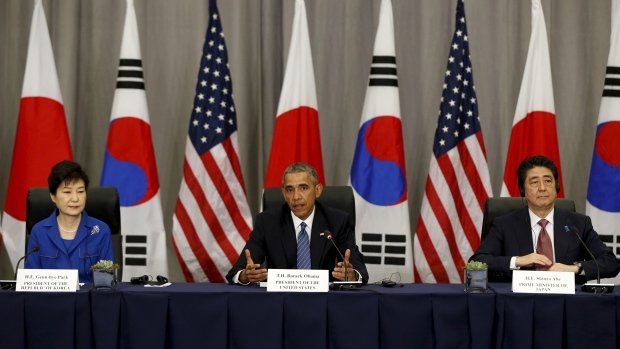
WASHINGTON: Meeting on the sidelines of the fourth Nuclear Security Summit (NSS) in Washington, US President Barack Obama, South Korean President Park Geun-hye and Japanese Prime Minister Shinzo Abe pledged to ramp up pressure on North Korea in response to its recent nuclear and missile tests. The three leaders agreed to deepen cooperation on deterring the North Korean nuclear threat and warned that they could take further steps to counter threats from Pyongyang. “We are united in our efforts to deter and defend against North Korean provocations,” Mr Obama said. “We recognise that our security is linked.” Mr Obama noted that the three leaders agreed that trilateral security cooperation is essential to maintaining peace and stability in Northeast Asia, deterring the North Korean nuclear threat and the potential of nuclear proliferation as a consequence of North Korean activities. As South Korea has been frequently threatened by Pyongyang, Ms Park warned that North Korea would face even stiffer sanctions and more isolation if it engaged in any further provocative acts. She also said that the mere fact the three leaders were huddling to discuss North Korea carried “huge significance.” Mr Abe also agreed with Mr Obama and Ms Parks concerns about North Korea, describing the challenge posed by Pyonygangs nuclear weapons as a special concern. Mr Abe said North Koreas nuclear and missile capability [are] a direct and grave threat not only to the three countries but to the global community. Under a trilateral arrangement, both Tokyo and Seoul would use Washington as an intermediary for intelligence sharing on North Koreas military and nuclear activities. In recent past, relations between South Korea and Japan have been bitter, but the two countries have come together in recent months by shared concerns about North Korea as Pyongyang conducted a fourth nuclear test in January and launched a long-range rocket into space in February. The US encouraged both these countries and its biggest allies in Asia to improve ties amid not only North Koreas provocations but increasing assertiveness of China in this region. Mr Obama also held a separate meeting with Chinese President Xi Jinping, the closest ally of North Korea, and said they both wanted to see “full implementation” of the latest United Nations sanctions against Pyongyang. However, Mr Xi has reportedly offered no sign that Beijing was prepared to go beyond its consent to the UN Security Council measures imposed in early March.