












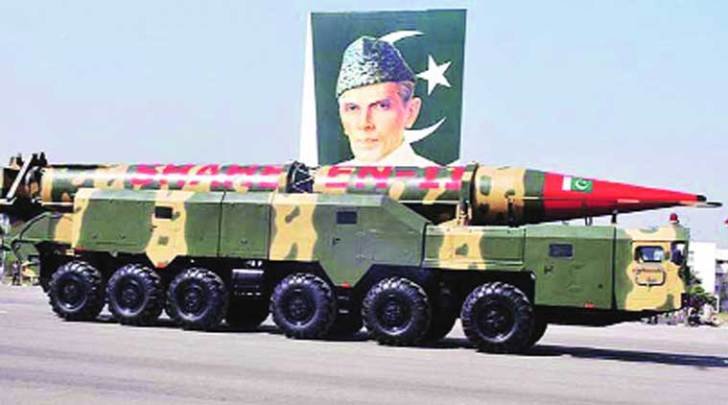
As India and Pakistan seek to improve bilateral ties despite the recent Pathankot terror attacks, a latest US Congressional report has said that Pakistan’s nuclear warheads estimated to be between 110-130 are aimed at deterring India from taking military action against it. The report also expressed concern that Islamabad’s “full spectrum deterrence” doctrine has increased risk of a nuclear conflict between the two South Asian neighbours. In the wake of the Pathankot terror attacks on January 2, India and Pakistan have rescheduled the foreign secretary level talks. “Pakistan’s nuclear arsenal probably consists of approximately 110-130 nuclear warheads, although it could have more. Islamabad is producing fissile material, adding to related production facilities, deploying additional nuclear weapons, and new types of delivery vehicles,” Congressional Research Service (CRS) said in its latest report. Noting that Pakistan’s nuclear arsenal is widely regarded as designed to dissuade India from taking military action against it, a 28-page CRS report has said Islamabad’s expansion of its nuclear arsenal, development of new types of nuclear weapons and adoption of a doctrine called “full spectrum deterrence” have led some observers to express concern about an increased risk of nuclear conflict between Pakistan and India. The report stated that India also continues to expand its nuclear arsenal. “Pakistan has in recent years taken a number of steps to increase international confidence in the security of its nuclear arsenal,” the report emphasised. According to a few officials from Pakistan and US, they argue that since the 2004 revelations about a procurement network run by former Pakistani nuclear official A. Q. Khan, Islamabad has taken a number of steps to improve its nuclear security and to prevent further proliferation of nuclear-related technologies and materials. Acknowledging the progress made by Pakistan in terms of its nuclear security, the CRS report observed that a number of important initiatives such as strengthened export control laws, improved personnel security, and international nuclear security cooperation programmes, have improved Pakistan’s nuclear security. Elaborating on the role of domestic instability in Pakistan, the report said: “However, instability in Pakistan has called the extent and durability of these reforms into question. Some observers fear radical takeover of the Pakistani government or diversion of material or technology by personnel within Pakistan’s nuclear complex.”