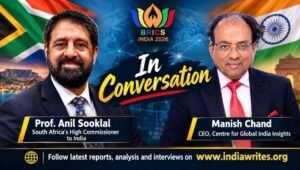

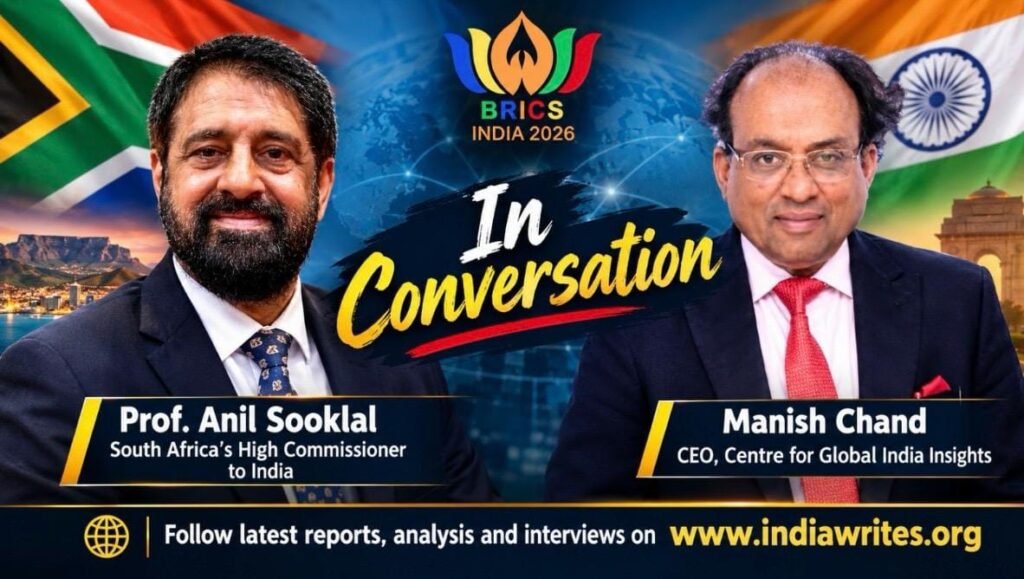
Q) What are South Africa’s expectations from the New Delhi summit?
A) India has assumed the chairship of BRICS this year at a very critical time for all of us, in terms of what’s happening not only on the geopolitical and security front, but also on the economic and financial front.
Now, you will recall that BRICS is based on three critical pillars of cooperation: political and security cooperation; economic and financial cooperation; and social and people-to-people cooperation. All three are receiving focus during India’s Chairship.
There is a great deal of interest in coming summit, and there are high expectations that all the BRICS leaders will come together in New Delhi in September. All the leaders recognise the importance of this summit and the timing of it, given the manifold challenges we are experiencing.
On the security front, we have serious fault lines in terms of what is going on in West Asia, the ongoing situation in Gaza, and, of course, the challenges in other global hotspots, including Africa and the ongoing situation in Russia and Ukraine.
All of this is having a serious impact on global security, stability, and economic growth. The summit will give BRICS leaders an opportunity to reflect on all these global hotspot challenges and apply their minds to how we bring stability to the global geopolitical and security environment. Even though some of these conflicts have continued for several years, the need for peace and stability remains critical.
I think equally important are the economic challenges. We have been experiencing serious challenges due to unilateral trade measures which are impacting all of us very negatively.
More recently, there have been further announcements of unilateral tariffs affecting all of us, including BRICS countries such as China, India, South Africa and, specifically, Brazil. At the same time, one has to recognise that the most vibrant economies today are within the BRICS family. While there is slow or poor growth among many countries of the Global North, we continue to see vibrant growth in many BRICS countries.
That is a positive sign. It also demonstrates the strength and resilience of BRICS economies. Despite these unilateral trade measures, which have been in place for the past eighteen months, they have not led to adverse growth in our countries.
On the contrary, while these measures have certainly created serious challenges, they have also provided an opportunity for BRICS to reflect on strengthening intra-BRICS trade, something we have been speaking about for a long time. And we are beginning to see the results of that.
The forthcoming BRICS Business Forum, from the 9th to the 11th of September here in Delhi, carries high expectations.
The BRICS Business Council and the BRICS Women’s Business Alliance are important structures. There is still considerable opportunity for us to deepen collaboration among ourselves. Intra-BRICS trade has grown significantly. It also gives us an opportunity to see how we can accelerate the pace of trade among ourselves, because the largest markets today are within the BRICS family. We keep speaking about BRICS’ collective GDP, which now rivals, and in some measures exceeds that of the G7.
These are all positive factors. But how do we build on this, not just for the benefit of our own people and countries, but for the Global South as a whole? And how do we act as a stimulus to the global economy? Because today BRICS is a stimulus to the global economy at a time when we are experiencing tremendous challenges and difficulties.
These are some of the issues that I believe will emerge in a very strong way. But equally important is financial architecture. More than a decade ago, we established the New Development Bank. It has demonstrated our capacity to rely on our own financial resources through the NDB in supporting our developmental agenda. Equally important are the challenges created by unilateral financial measures imposed on some BRICS countries.
These have prompted us to look at how we deepen financial cooperation. You will recall that at the Johannesburg Summit in 2023, Finance Ministers and Central Bank Governors were tasked with looking at alternative payment and settlement systems. I hope we will begin to see the results of that work.
Q: Are we moving in the direction of a BRICS payment mechanism? Or is it going to be more about settlement and trading in local currencies?
A: The first step is settlement in local currencies. But the logical step thereafter is to move in that direction. It is inevitable.
Q: What about de-dollarisation? Is it one or two countries that are just pushing for it?
A: Well, as BRICS, we have never used the term “de-dollarisation.” In no BRICS document or summit declaration will you find the term “de-dollarisation.” BRICS is not about de-dollarisation. BRICS is about looking at how we become more independent in terms of the financial instruments we have at our disposal and not being as vulnerable as we have been in the past.
We have made tremendous strides in this regard. The issue of the dollar as the currency of choice in global settlements and trade is a natural process because the global economic basket has changed so dramatically. Naturally, the financial basket is going to change as well.
Q: What about the proposal for a digital currency in BRICS? Is it gaining traction?
A: I think that could be one of the major initiatives and outcomes of India’s Chairship. From what I have gathered thus far from the finance track, there is an appetite for it. And it is a logical development.
Q: Talking about other outcomes, you spoke about prioritisation of the economic agenda, more intra-BRICS trade, and investment and all that. But also, given the turbulent global situation, what role do you think BRICS can play in stabilising, specifically, the West Asia situation?
A: BRICS must remain engaged with the situation in West Asia. They have been. And I think what we are seeing is a leadership vacuum, a global leadership vacuum. No one country can occupy that space.
Today, we are already in a multipolar world. BRICS’ past declarations speak of a multipolar global system. We are there, and BRICS is at the centre of it. BRICS has an opportunity to provide leadership. We are lacking leadership at every level today. BRICS is steeped in multilateralism. Every BRICS Summit outcome document speaks about reinforcing, strengthening, and reinvigorating the global multilateral architecture, both on the political and security front and on the economic and financial front. This is where BRICS has to constantly reiterate the call.
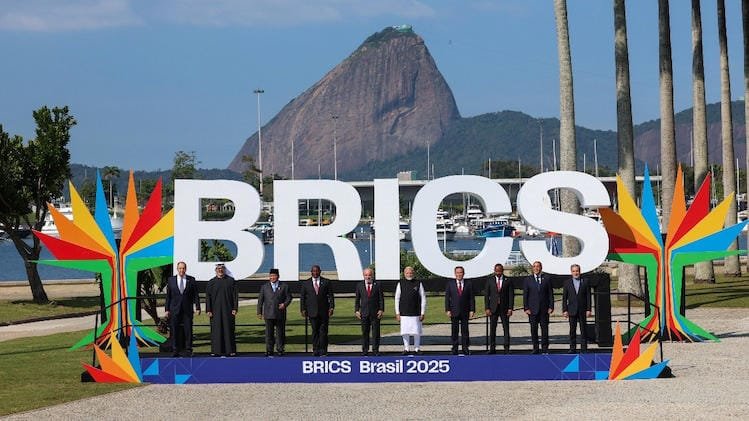
Q: Reforming the global governance architecture has been an abiding theme of BRICS right from its inception. Do you think there has been tangible movement? What results have been achieved so far, and what can we expect at the forthcoming summit?
A: The fact that the global community, including the Secretary-General of the United Nations, and many leaders from the Global North have been articulating the need for major reform of the global multilateral architecture. It is this agenda that has been a constant of BRICS for almost twenty years since BRICS came together. This is the value of BRICS constantly speaking about reform in a strong manner and keeping it on the global agenda. Because it suits some of our friends to keep quiet on global reform, especially UN Security Council reform. That is critical.
It must remain on the agenda. It must be spoken about. And it must remain at the forefront of the BRICS agenda. Reform is something BRICS has consistently spoken about. But more than that, we need to apply global pressure to ensure that these meaningful reforms move forward.
Q: BRICS is an eleven-member grouping with more than ten partner countries. There are another thirty or forty countries lined up seeking membership and partner status. So, BRICS is in high demand. What is the latest position on expansion? Is the grouping going to expand further?
A: Yes, there will be expansion, but not in the immediate future.
When South Africa joined and BRICS became five, we also spoke about expansion. In 2018, when South Africa held the Chairship, our leaders said, “No. Let us consolidate first.” We need a similar moment of consolidation.
Taking in six additional members means doubling the membership of an organisation that had functioned very cohesively. It took quite some time for us to understand each other and to work together. That is what we need now. We need some time to consolidate this new membership of eleven and to refine our working mechanisms. The newly joined members need time to understand the BRICS working methods and the BRICS culture. We must all move at the same pace. We do not want a two-speed BRICS, where those who have been there since the beginning move at one pace while the new members move at another. The new members have to be fully integrated and equally part of the consensus-based approach on which BRICS functions.
Q: There is still no complete consensus on one or two sticky issues. The most important is the Iran-UAE divide over the formulation to be used to describe the conflict in West Asia. Are there still consensus issues being debated? And can we expect, in your view, an outcome document, a joint declaration?
A: I am confident we will have an outcome document. Yes, as we saw during the Foreign Ministers’ Meeting, we did not get consensus around the language relating to Iran and the UAE. That was in May.
Since then, discussions have continued. And I am confident that when our leaders come together, there will be consensus language that accommodates all parties while ensuring that we have a common BRICS position.
Q: U.S. President Donald Trump has been a vocal critic of BRICS. There is also a narrative in the West about BRICS challenging the West-dominated world order. How do you look at this critique of BRICS?
A: Well, I think it’s natural. When you have been in power for such a prolonged period, and new players emerge that are equally powerful and want a place at the high table, it is not always easy to make room. But it is inevitable. We should view the criticism in a negative light. The fact that attention is now focused on BRICS is itself a positive sign.
Q: India has placed the Global South at the centre of its BRICS agenda. Earlier, during India’s G20 Presidency, the Global South was also front and centre. In what ways can India and South Africa intensify collaboration to promote the interests of the Global South? And what concrete outcomes can we expect at the summit?
A: Keeping the Global South at the centre of the BRICS agenda is critical. Countries like India and South Africa are central to that effort. The Global South must provide leadership. And that leadership will come through the instrument of BRICS. India’s Chairship is crucial to that.