

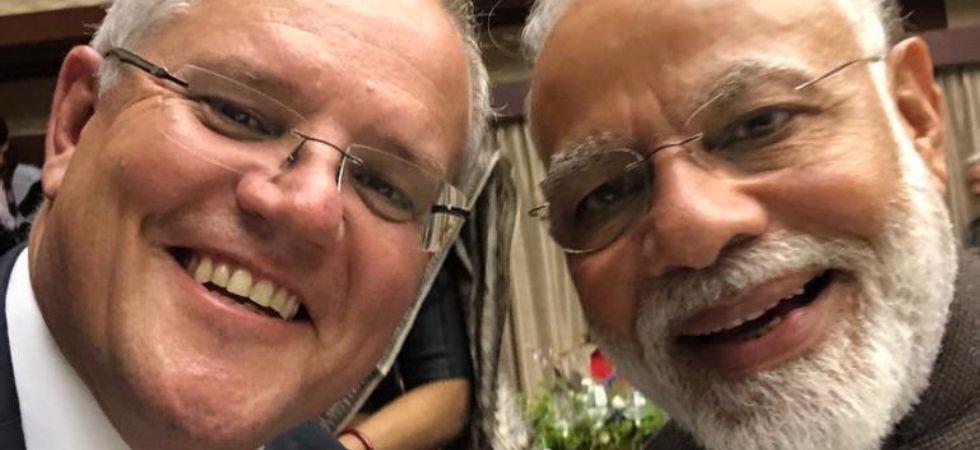
 Against the backdrop of ongoing geopolitical realignments and growing economic synergies, India’s multi-faceted relations with Australia are poised to move into a higher orbit. Building on their complementary strengths and capabilities, the two countries are set to scale up their economic partnership, a process that has acquired a new energy after the publication of “An India Economic Strategy to 2035” paper by Peter Varghese and endorsed by the Australian Government last year. On the strategic plane, shared strategic interests and near identical values are propelling the two countries into a closer strategic partnership, both bilaterally and in mini-lateral formats like the Quad.
 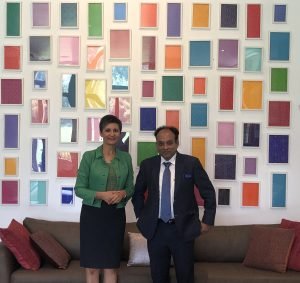 As India and Australia celebrate the 75th anniversary of the establishment of their diplomatic relations, Australia’s High Commissioner to India Harinder Sidhu speaks to Manish Chand, Editor-in-Chief, India and World& India Writes Network, about latest developments in this rapidly growing partnership and her vision of where it is headed in years to come. “There is no reason why Australia and India cannot have the strongest partnership of any two countries in the Indo-Pacific,” says the Indian-born Sidhu in this free-wheeling conversation with India and World. (Excerpts from the interview) Q) Over the years, India and Australia have forged a robust strategic and economic partnership. Can one expect the current momentum in India-Australia relations to continue under the new dispensation in New Delhi and Canberra? A) In the last few years, we built a very strong strategic partnership, and we are in the process of building a very strong economic partnership. The driving force behind the relationship has been an understanding on both sides on how well strategically aligned we are. This relationship is being built on a very clear understanding of shared national interests. One shared strategic element is that we are both democracies. During a recent trip to Mumbai, I visited some of the polling stations there. Watching Indians go to the elections is like watching Australians go to the elections — there is a same feeling in the air. Enhancing Economic Ties Q) Australia’s foreign policy has identified India as a priority country. India-Australia economic relations are on an upward curve, but given the potential, the economic partnership is still underperforming. Last year, former foreign secretary Peter Varghese delivered “An India Economic Strategy to 2035”, . Building on this document, how do you see India and Australia intensifying economic relations in days to come?
  A) Both countries have thought it worth our while to invest time, energy and resources in thinking about how we will take the economic relationship forward. The India Economic Strategy is more than 500 pages long; it’s a serious document. It took us more than one year to develop. It’s a mark of our seriousness of intent. But you are right that it’s an underdone economic relationship. India’s share of Australia’s global trade of goods and services is about 3.6% of our global goods and services trade. India is, however, still our fifth largest trading partner. But that 3.6% is what we trade with New Zealand – so there is no comparison in the size of the market. There is a lot of scope. As we move forward in implementing the India Economic Strategy, we have identified 10 priority economic sectors to work in: the four leading sectors are education, tourism, resources and agri business. We are looking on how to strengthen and deepen this economic relationship in these areas. We are aiming to develop an economic relationship with India, which will not resemble what we have with any other Asian country. It will be very focused on people-to-people links; it will be highly services-focused and very consumption-driven. We are now examining how both India and Australia can derive maximum benefits from this economic relationship. I am very interested to see the reverse Australia economic strategy that the Indian government is producing. We will be closely looking at areas where we can really form partnerships. Q) What about the status of CECA (Comprehensive Economic Cooperation Agreement)? The India-Australia CECA remains a work in progress, and continues to be mired in fundamental differences. A) Nobody ever pretends that negotiating a free-trade agreement is a simple task. The text of the CECA is more than 1,000-pages long. It’s complex and will take time. The reason we commissioned the India Economic Strategy is a recognition that a free-trade agreement alone is not an economic relationship. The economic relationship is going to be bigger than that. Trade will continue in the absence of a free-trade agreement. There are opportunities on both sides that we risk missing because we are so focused on the free-trade agreement alone. We have to, therefore, see the economic relationship as CECA plus, and not just CECA. I am very confident that we will have a free-trade agreement between India and Australia at some point in the future. Both countries are committed to it; it is something that we continue to work on, but it’s not the only thing we are going to do together. The CECA is a tool and an enabler to accelerate what we are trying to do in the larger economic relationship. For example, some Australian professional qualifications are not recognised in India, and if they were recognised, we can see much more flow of services. Q) How do you look at the progress in the RCEP (Regional Comprehensive Economic Partnership) negotiations? A) The RCEP has several tracks. There are tracks for countries who have a free-trade agreement (FTA) with each other, and tracks for those who don’t have FTAs with each other. Australia and India fall into that category of countries who don’t have FTAs; so, we have to agree to things bilaterally before we can bring it to the group. I am actually quite optimistic about the RCEP; we have made quite a lot of progress in recent times. The Indian government is very seized of the importance of the RCEP. I always worry about putting a timeline on trade agreements – this is always a dangerous thing because that becomes the success point rather than the quality of it. The RCEP is extraordinarily important for India as it’s the first significant regional trade agreement that India has been involved in. It’s an Indo-Pacific trade agreement; it will have an enormous impact on economic integration. If we can conclude the RCEP, there would be a tremendous boost to the economic cohesion of the Indo-Pacific, just by virtue of the trading relationships that we’ve built. Partnering in Indo-Pacific Q) The Indo-Pacific has acquired a new salience in the foreign policy matrix of both India and Australia. How do you envisage cooperation between India and Australia in the Indo-Pacific region?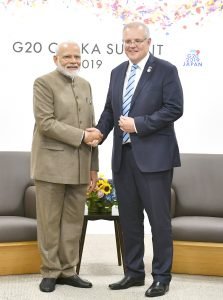
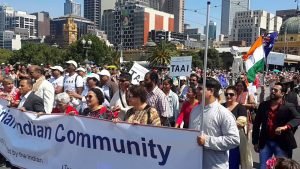 A) Australia is a very diverse multi-cultural country; we have got people from 200 different backgrounds in Australia, all of whom have made a fantastic contribution to our country. The Indian diaspora is now the fastest growing in Australia, and at last count we had around 70,000 Australians of Indian Origin. This includes around half a million Australian-Indians who were born in India, which works out to 2% of our population. So, 1 in 50 Australians was born in India. The Indian diaspora has grown significantly in the last decade – the population of Indian-born Australians has more than tripled in the last decade. I am very optimistic about what the Indian diaspora can achieve in Australia in the coming years. As the diaspora matures, it’s going to play a bigger and bigger role in the Australian system. The Indian diaspora in Australia is still very young. Most people who have come to Australia in the last 10 years are young people. You can already see the change. In the state of Western Australia, despite being young, five people of Indian origin were elected to the parliament in the last election. That’s phenomenal! Young Indians are also getting into business and government. The Long View Q) India-Australia relations often gets confused with 3C’s: Cricket, Commerce and Curry. Taking a long-range view, how do you see the future of India-Australia relations? A) This year is the 75th anniversary of the establishment of diplomatic relations between India and Australia. We established diplomatic relations before independence – the first Australian High Commissioner arrived in New Delhi in January 1944. Therefore, it seems to me a terrible shame that the two countries that are so similar in the things we value and the way we look at the world – the best we can say about the last 70 years are the three Cs. Surely, we could do more than that. What I see us heading towards is two countries that I believe should be the strongest friends in the Indo-Pacific. There is no reason why Australia and India cannot have the strongest partnershipof any two countries in the Indo-Pacific. We both are democracies, we both look at the world the same way, we both have complementary economies, we both have almost identical strategic interests, and we both have far more in common than we have things that are different. When an Australian and an Indian sit down together, the conversation is easy, open and free. What I am really happy to see is that’s exactly where it’s going.