Organised through the collaborative efforts of the Ministry of Culture, UT Ladakh Administration, the International Buddhist Confederation, National Museum of India, the Archaeological Survey of India, the Ladakh Buddhist Association, the Ladakh Gonpa Association and other institutions, the exposition reflected India’s growing use of Buddhist heritage as an instrument of cultural diplomacy and global outreach.
The event coincided with the observance of the 2569th Vesak Buddha Purnima and witnessed an unprecedented public display of the sacred Piprahwa relics associated with Lord Buddha. These relics, preserved at the National Museum in New Delhi, were brought to Ladakh allowing devotees, monks, scholars, tourists and international observers an opportunity for veneration and reflection.
The Holy Relic Exposition represented the convergence of spirituality and statecraft. Through this initiative, India projected itself as the custodian of the Buddha’s heritage and reinforced its civilisational identity in the international arena. The exposition highlighted how Buddhism continues to serve as an important pillar of India’s soft power diplomacy, especially in Asia and the Himalayan region.
Buddha Purnima and the Sacred Geography of Ladakh
Buddha Purnima commemorates the birth, enlightenment, and Mahaparinirvana of Gautama Buddha and remains the holiest day for Buddhists across the world. In 2026, the celebration assumed special significance in India because Ladakh became the focal point of the observance. Ladakh, often described as a “living land of Dhamma,” possesses deep historical and spiritual connections with Buddhism through monasteries, traditions and trans-Himalayan cultural exchanges.
The selection of Ladakh as the venue carried immense symbolic meaning. The region historically functioned as an important node in the Silk Route network that connected India with Central Asia, Tibet and East Asia. Buddhist monks, manuscripts, art and philosophical traditions travelled through these routes, helping spread Indian civilisation across Asia. The exposition therefore revived Ladakh’s historical role as a bridge between India and the Buddhist world.
Ladakh is also prominent in terms of its critical location along the India-China border. There have been several occasions when due to high tension along the border, people of Ladakh have contributed significantly towards supporting the defence fences during their movements.
The celebrations were organised across important centres such as Jivetsal, Dharma Centre, Central Institute of Buddhist Studies and Mahabodhi International meditation Cere in Leh and Karsha Photang Gompa in Zanskar. Public processions, prayers, meditation sessions, conferences, cultural performances, and exhibitions accompanied the exposition of the sacred relics. Thousands of devotees from across Ladakh and other parts of India gathered for darshan of the relics, creating a spiritually charged atmosphere marked by reverence and unity.
The extension of the exposition to Zanskar carried additional significance. Remote Himalayan communities were directly connected to a national and international Buddhist initiative, demonstrating India’s commitment to preserving Himalayan Buddhist traditions and integrating them into broader cultural diplomacy efforts. This was also a special gesture for the old and the infirm and beyond and who live in the region and beyond and who can probably never see the relics otherwise.
The Historical Significance of the Holy Relics
The relics displayed during the exposition originated from Piprahwa in present-day Uttar Pradesh, identified by many scholars with ancient Kapilavastu, associated with the Shakya clan of Gautama Buddha. These relics were discovered in 1898 beneath an ancient stupa and remain among the most sacred Buddhist relics in the world.
Their display in Ladakh symbolised the return of the Buddha to the Himalayan land of devotion. The exposition also acquired historical significance because the relics had recently been repatriated and preserved as part of India’s cultural heritage initiatives. The Indian government presented the exposition as a reaffirmation of India’s civilisational responsibility toward preserving Buddhist heritage for humanity.
The movement of the relics from the National Museum to Ladakh through coordinated efforts involving religious institutions, government agencies, and Buddhist organisations demonstrated the integration of state institutions with cultural diplomacy. The relics thereby became not only sacred objects of worship but also symbols of India’s civilisational continuity and heritage preservation.
India’s Buddhist Soft Power Diplomacy
Soft power refers to the ability of a country to influence others through culture, values, heritage and ideas rather than coercion or military force. Buddhism has increasingly become one of India’s most effective instruments of soft power diplomacy. As the land of the Buddha’s birth, enlightenment, teachings and Mahaparinirvana, India possesses unmatched spiritual legitimacy in the Buddhist world.
The Ladakh Holy Relic Exposition represented a major example of this strategy. By organising a large-scale international Buddhist event in the Himalayan region, India reinforced its image as the natural centre of global Buddhism.
In recent years, India has significantly expanded its Buddhist diplomacy by reviving and promoting its civilisational links with the Buddhist world through a range of cultural, academic and spiritual initiatives. The revival of Nalanda University has symbolised India’s effort to reconnect with its ancient legacy as a global centre of Buddhist learning and intellectual exchange. Alongside this, India has regularly organised international Buddhist conclaves and dialogues that bring together monks, scholars, diplomats and practitioners from across Asia and beyond to strengthen cultural and spiritual cooperation.
India has also undertaken restoration and conservation projects at important Buddhist heritage sites in several countries, reflecting its commitment to preserving shared Buddhist traditions and historical connections. The promotion of Buddhist tourist circuits linking sacred sites associated with the life of Lord Buddha, including Lumbini, Bodh Gaya, Sarnath and Kushinagar, has further reinforced India’s role as the spiritual homeland of Buddhism. Moreover, initiatives such as the Global Buddhist Summit have provided an international platform to discuss Buddhism’s relevance in addressing contemporary global challenges such as conflict, climate change and ethical governance. In addition, sacred relic expositions organised in India and abroad have emerged as powerful instruments of cultural outreach, drawing thousands of devotees while deepening India’s people-to-people and civilisational ties with Buddhist-majority societies across the world.
These initiatives have strengthened India’s engagement with countries such as Sri Lanka, Thailand, Myanmar, Vietnam, Japan, Mongolia, Bhutan, and other Buddhist-majority societies. Buddhism enables India to connect with these nations through shared civilisational values rather than geopolitical competition. India has also held a relic exposition in the Russian Autonomous Republic of Kalmykia which had an overwhelming Buddhist population.
The Ladakh exposition added a unique Himalayan dimension to this diplomacy. It highlighted India’s cultural links with Tibetan Buddhism and underscored the importance of preserving Buddhist traditions in the Himalayan belt. At a time of geopolitical competition in Asia, such initiatives help India project moral and cultural leadership rooted in peace, compassion, and dialogue.
Role of the International Buddhist Confederation
The International Buddhist Confederation plays a major role in conceptualising and coordinating the exposition alongside governmental and monastic institutions. Being the highest platform for implementing Indian Buddhist policies, the participation of the IBC reflected the growing importance of transnational Buddhist networks in India’s cultural diplomacy architecture.
The organisation of conferences on Himalayan Buddhism, cultural programmes, exhibitions, film screening and spiritual discussions during the exposition demonstrated that the event was intellectually and diplomatically significant in addition to being religiously meaningful. Scholars, monks, diplomats, and practitioners engaged in discussions on preserving Buddhist heritage and applying Buddhist philosophy to contemporary global challenges.
Such initiatives align with the broader objectives of the Global Buddhist Summit, which seeks to position Buddhism as a framework for addressing issues such as conflict, environmental degradation, and ethical governance.
Buddhism as India’s Message of Peace
One of the most important aspects of the Ladakh exposition was the repeated emphasis on world peace. Government leaders described the exposition as a message from India to humanity during a period marked by wars, geopolitical tensions, and global uncertainty.
The teachings of Buddha centred on compassion, non-violence, moderation, and harmony. By foregrounding these teachings during Buddha Purnima celebrations, India projected an image of itself as a civilisational state rooted in peace and dialogue. This moral positioning enhances India’s international image and complements its foreign policy outreach.
The symbolism of displaying the sacred relics in the Himalayas was especially powerful. The Himalayas have historically been viewed as a sacred space of meditation and spiritual pursuit. Hosting the exposition in Ladakh transformed the region into a global spiritual centre during Buddha Purnima and reinforced India’s civilisational identity.
Conclusion
The Buddha Purnima celebrations and Holy Relic Exposition in Ladakh in 2026 represented far more than a religious observance. They showcased how India is successfully integrating heritage, spirituality, diplomacy, and cultural identity into a coherent soft power strategy.
The exposition reaffirmed India’s role as the custodian of Buddhist heritage and highlighted Ladakh’s importance as a living centre of Himalayan Buddhism. Through the sacred relics, India connected ancient history with contemporary diplomacy, projecting values of peace, compassion, and coexistence to the world.
At a time when global politics is increasingly shaped by hard power competition, India’s Buddhist diplomacy offers an alternative rooted in shared values and civilisational dialogue. The Ladakh Holy Relic Exposition therefore stands as an important milestone in India’s evolving cultural diplomacy and its efforts to position Buddhism as a bridge between nations and peoples.



India’s Buddhist Diplomacy in Ladakh
Organised through the collaborative efforts of the Ministry of Culture, UT Ladakh Administration, the International Buddhist Confederation, National Museum of India, the Archaeological Survey of India, the Ladakh Buddhist Association, the Ladakh Gonpa Association and other institutions, the exposition reflected India’s growing use of Buddhist heritage as an instrument of cultural diplomacy and global outreach.
The event coincided with the observance of the 2569th Vesak Buddha Purnima and witnessed an unprecedented public display of the sacred Piprahwa relics associated with Lord Buddha. These relics, preserved at the National Museum in New Delhi, were brought to Ladakh allowing devotees, monks, scholars, tourists and international observers an opportunity for veneration and reflection.
The Holy Relic Exposition represented the convergence of spirituality and statecraft. Through this initiative, India projected itself as the custodian of the Buddha’s heritage and reinforced its civilisational identity in the international arena. The exposition highlighted how Buddhism continues to serve as an important pillar of India’s soft power diplomacy, especially in Asia and the Himalayan region.
Buddha Purnima and the Sacred Geography of Ladakh
Buddha Purnima commemorates the birth, enlightenment, and Mahaparinirvana of Gautama Buddha and remains the holiest day for Buddhists across the world. In 2026, the celebration assumed special significance in India because Ladakh became the focal point of the observance. Ladakh, often described as a “living land of Dhamma,” possesses deep historical and spiritual connections with Buddhism through monasteries, traditions and trans-Himalayan cultural exchanges.
Ladakh is also prominent in terms of its critical location along the India-China border. There have been several occasions when due to high tension along the border, people of Ladakh have contributed significantly towards supporting the defence fences during their movements.
The celebrations were organised across important centres such as Jivetsal, Dharma Centre, Central Institute of Buddhist Studies and Mahabodhi International meditation Cere in Leh and Karsha Photang Gompa in Zanskar. Public processions, prayers, meditation sessions, conferences, cultural performances, and exhibitions accompanied the exposition of the sacred relics. Thousands of devotees from across Ladakh and other parts of India gathered for darshan of the relics, creating a spiritually charged atmosphere marked by reverence and unity.
The extension of the exposition to Zanskar carried additional significance. Remote Himalayan communities were directly connected to a national and international Buddhist initiative, demonstrating India’s commitment to preserving Himalayan Buddhist traditions and integrating them into broader cultural diplomacy efforts. This was also a special gesture for the old and the infirm and beyond and who live in the region and beyond and who can probably never see the relics otherwise.
The Historical Significance of the Holy Relics
The relics displayed during the exposition originated from Piprahwa in present-day Uttar Pradesh, identified by many scholars with ancient Kapilavastu, associated with the Shakya clan of Gautama Buddha. These relics were discovered in 1898 beneath an ancient stupa and remain among the most sacred Buddhist relics in the world.
Their display in Ladakh symbolised the return of the Buddha to the Himalayan land of devotion. The exposition also acquired historical significance because the relics had recently been repatriated and preserved as part of India’s cultural heritage initiatives. The Indian government presented the exposition as a reaffirmation of India’s civilisational responsibility toward preserving Buddhist heritage for humanity.
The movement of the relics from the National Museum to Ladakh through coordinated efforts involving religious institutions, government agencies, and Buddhist organisations demonstrated the integration of state institutions with cultural diplomacy. The relics thereby became not only sacred objects of worship but also symbols of India’s civilisational continuity and heritage preservation.
India’s Buddhist Soft Power Diplomacy
Soft power refers to the ability of a country to influence others through culture, values, heritage and ideas rather than coercion or military force. Buddhism has increasingly become one of India’s most effective instruments of soft power diplomacy. As the land of the Buddha’s birth, enlightenment, teachings and Mahaparinirvana, India possesses unmatched spiritual legitimacy in the Buddhist world.
In recent years, India has significantly expanded its Buddhist diplomacy by reviving and promoting its civilisational links with the Buddhist world through a range of cultural, academic and spiritual initiatives. The revival of Nalanda University has symbolised India’s effort to reconnect with its ancient legacy as a global centre of Buddhist learning and intellectual exchange. Alongside this, India has regularly organised international Buddhist conclaves and dialogues that bring together monks, scholars, diplomats and practitioners from across Asia and beyond to strengthen cultural and spiritual cooperation.
India has also undertaken restoration and conservation projects at important Buddhist heritage sites in several countries, reflecting its commitment to preserving shared Buddhist traditions and historical connections. The promotion of Buddhist tourist circuits linking sacred sites associated with the life of Lord Buddha, including Lumbini, Bodh Gaya, Sarnath and Kushinagar, has further reinforced India’s role as the spiritual homeland of Buddhism. Moreover, initiatives such as the Global Buddhist Summit have provided an international platform to discuss Buddhism’s relevance in addressing contemporary global challenges such as conflict, climate change and ethical governance. In addition, sacred relic expositions organised in India and abroad have emerged as powerful instruments of cultural outreach, drawing thousands of devotees while deepening India’s people-to-people and civilisational ties with Buddhist-majority societies across the world.
These initiatives have strengthened India’s engagement with countries such as Sri Lanka, Thailand, Myanmar, Vietnam, Japan, Mongolia, Bhutan, and other Buddhist-majority societies. Buddhism enables India to connect with these nations through shared civilisational values rather than geopolitical competition. India has also held a relic exposition in the Russian Autonomous Republic of Kalmykia which had an overwhelming Buddhist population.
The Ladakh exposition added a unique Himalayan dimension to this diplomacy. It highlighted India’s cultural links with Tibetan Buddhism and underscored the importance of preserving Buddhist traditions in the Himalayan belt. At a time of geopolitical competition in Asia, such initiatives help India project moral and cultural leadership rooted in peace, compassion, and dialogue.
Role of the International Buddhist Confederation
The International Buddhist Confederation plays a major role in conceptualising and coordinating the exposition alongside governmental and monastic institutions. Being the highest platform for implementing Indian Buddhist policies, the participation of the IBC reflected the growing importance of transnational Buddhist networks in India’s cultural diplomacy architecture.
The organisation of conferences on Himalayan Buddhism, cultural programmes, exhibitions, film screening and spiritual discussions during the exposition demonstrated that the event was intellectually and diplomatically significant in addition to being religiously meaningful. Scholars, monks, diplomats, and practitioners engaged in discussions on preserving Buddhist heritage and applying Buddhist philosophy to contemporary global challenges.
Such initiatives align with the broader objectives of the Global Buddhist Summit, which seeks to position Buddhism as a framework for addressing issues such as conflict, environmental degradation, and ethical governance.
Buddhism as India’s Message of Peace
One of the most important aspects of the Ladakh exposition was the repeated emphasis on world peace. Government leaders described the exposition as a message from India to humanity during a period marked by wars, geopolitical tensions, and global uncertainty.
The symbolism of displaying the sacred relics in the Himalayas was especially powerful. The Himalayas have historically been viewed as a sacred space of meditation and spiritual pursuit. Hosting the exposition in Ladakh transformed the region into a global spiritual centre during Buddha Purnima and reinforced India’s civilisational identity.
Conclusion
The Buddha Purnima celebrations and Holy Relic Exposition in Ladakh in 2026 represented far more than a religious observance. They showcased how India is successfully integrating heritage, spirituality, diplomacy, and cultural identity into a coherent soft power strategy.
The exposition reaffirmed India’s role as the custodian of Buddhist heritage and highlighted Ladakh’s importance as a living centre of Himalayan Buddhism. Through the sacred relics, India connected ancient history with contemporary diplomacy, projecting values of peace, compassion, and coexistence to the world.
At a time when global politics is increasingly shaped by hard power competition, India’s Buddhist diplomacy offers an alternative rooted in shared values and civilisational dialogue. The Ladakh Holy Relic Exposition therefore stands as an important milestone in India’s evolving cultural diplomacy and its efforts to position Buddhism as a bridge between nations and peoples.
Portia Conrad
Related Posts
Diplomatic win for India: BRICS bridges Gulf divide, bats for Global South
Illuminating India’s BRICS moment
With Trump listening in, Iran urges PM Modi to end war with US
India Russia ‘dosti’ in Bishkek: Focus on end of Ukraine war, balanced trade
Uncovering Pakistan: Modi rallies SCO against states that use terror as policy
Modi’s SCO agenda: Shaping a region free of terror, widening arc of prosperity
Latest Events
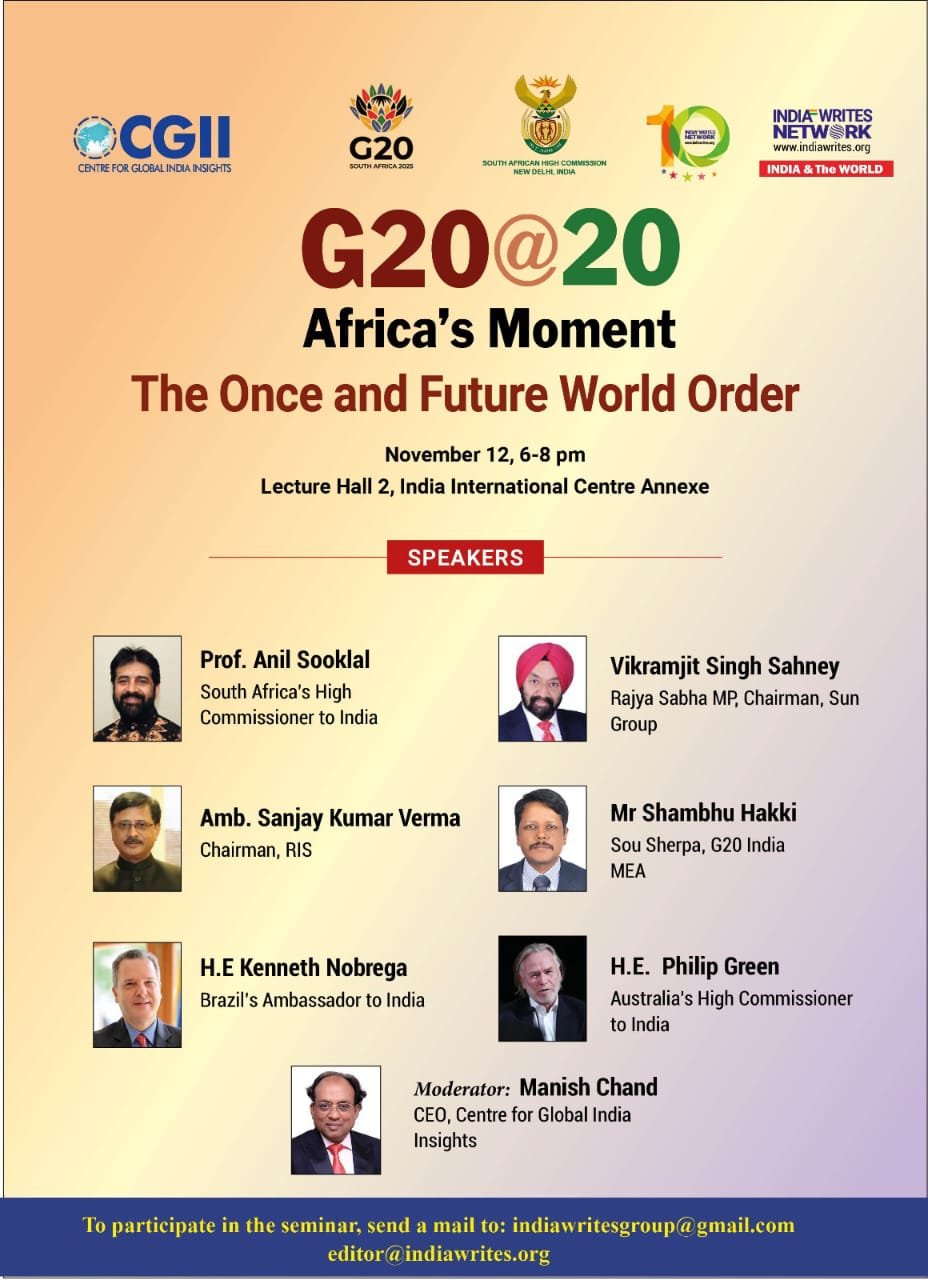
G20@20: Africa’s Moment – The Once and Future World Order
Speakers
Professor Anil Sooklal
Kenneth da Nobrega
Manish Chand
Ambassador Philip Green
Sanjay Kumar Verma
Shambhu Hakki
Vikramjit Singh Sahney
MPs, diplomats laud Operation Sindoor, call for national unity to combat Pakistan-sponsored terror
Speakers
Aparajita Sarangi
Brij Lal
Dr Amar Patnaik
Manish Chand
Priyanka Chaturvedi
Sujan Chinoy
Yashvardhan Kumar Sinha
BRICS summit in Rio to focus on Global South, local currency trade
Speakers
Dammu Ravi
Denis Alipov
Ina Hagniningtyas Krisnamurthi
Jyoti Vij
Kamel Zayed Kamel Galal
Kenneth da Nobrega
Manish Chand
Book
India’s G20 Legacy: Shaping a New World Order
Editor: Manish Chand
Pages: 206
Publisher: Pentagon Press LLP
Cover Price: INR 995
In Conversation
India’s BRICS Chairship Critical for Global South: South Africa’s Envoy
In The Press
Rescuing G20 from North-South divide: Ubuntu Moment
The Sunday Guardian: India calls for strengthened BRICS cooperation
Daily Excelsior: Ahead BRICS summit in Rio, envoys call for greater focus on combating terrorism
Rediff: BRICS Summit 2024: Focus on National Currencies
Latest From CGII
Diplomatic win for India: BRICS bridges Gulf divide, bats for Global South
Illuminating India’s BRICS moment
With Trump listening in, Iran urges PM Modi to end war with US
India Russia ‘dosti’ in Bishkek: Focus on end of Ukraine war, balanced trade
Uncovering Pakistan: Modi rallies SCO against states that use terror as policy
Modi’s SCO agenda: Shaping a region free of terror, widening arc of prosperity
The Journal
Special Edition on India’s Indo-Pacific plus Diplomacy
India’s G20 Journey – Scaling A New Summit