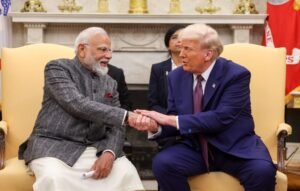
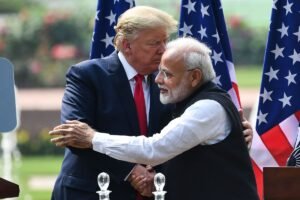


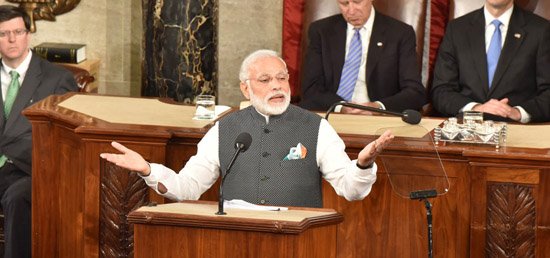
“A new symphony is in place” between the once estranged, and now conjoined democracies. With his soaring speech before the joint session of the US Congress, India’s Prime Minister Narendra Modi has heralded a distinctly new era in the India-US relations, signalling an end to “hesitations of history” and chronic ambivalence in what President Barack Obama has called “the defining partnership of the 21st century.” In his 45-minute speech, punctuated with more than 45 round of ringing applause, the Indian leader, whose life story exemplifies the twinning of Indian and American dreams, conquered the hearts and minds of America. The Great Indian Dream 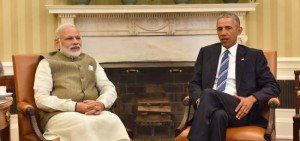 It was a resonant speech that came straight from the heart, and sought to yoke India’s developmental aspirations with the transformative power of American capital, technology and enterprise. The Indian leader’s message to America was simple but potent: a strong and powerful India is in the interests of America and the world. “Our 800 million youth are particularly impatient. India is undergoing a profound social and economic change. A billion of its citizens are already politically empowered. My dream is to economically empower them through many social and economic transformations. And do so by 2022, the 75th anniversary of India’s independence,” he said to applause from a packed House, with a generous sprinkling of Indian-Americans in attendance. “These are not just aspirations. They are goals to be reached in a finite time-frame. And to be achieved with a light carbon foot print, with greater emphasis on renewables,” he added. His emphasis on his commitment to low-carbon green future for India drew a loud applause from assembled Congressmen. Strategic Convergence Mr Modi’s speech was not just a string of grandiloquent rhetoric, designed to impress Americans. In his shining new vision of the India-US relations, strategic convergence and geopolitics figured prominently in discussions. In an all-too-obvious reference to Pakistan, Mr Modi lauded the Congressmen for their forthright stand by refusing to reward those who practise terrorism, which alluded to the US Congress’s recent objection to American government funding purchase of US F-16 fighter jets by Pakistan. Pitching for “deepening security cooperation” with Afghanistan, Mr Modi put counter-terrorism on top of the agenda. “In the territory stretching from west of India’s border to Africa, it (terrorism) may go by different names, from Laskhar-e-Toiba, to Taliban to ISIS… But its philosophy is common: of hate, murder and violence.” “Although its (terrorism’s) shadow is spreading across the world, it is incubated in India’s neighbourhood. I commend members of the US Congress for sending a clear message to those who preach and practise terrorism for political gains. Refusing to reward them is the first step towards holding them accountable for their actions.” Against the backdrop of the flux in the Asia-Pacific and growing Chinese assertiveness in the region, he underlined the need for “promoting cooperation not dominance, connectivity not isolation, respect for global commons, inclusive not exclusive mechanisms, and above all adherence to international rules and norms.” “In Asia, the absence of an agreed security architecture creates uncertainty. Threats of terror are expanding, and new challenges are emerging in cyber and outer-space. And global institutions, conceived in 20th century, seem unable to cope with new challenges or take on new responsibilities… Our engagement can make a difference by promoting cooperation not dominance, connectivity not isolation, respect for global commons, inclusive not exclusive mechanisms, and above all adherence to international rules and norms.” With this all-encompassing vision of the India-US relations, India and the US are set to get locked into a tighter strategic embrace and cooperate proactively in shaping an inclusive 21st century.